|
|
|
1579 zł
|
|
price without VAT: 1283,74 zł
|
| |
 Shop online: Shop online:
● not available
Shop in Warsaw (qty):
● not available
Shop in Chorzow (qty):
● not available
|
|
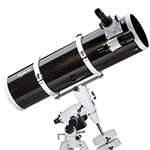
Sky-Watcher N-200/1000 OTA is a complete optical tube of the Newton system with a main mirror diameter of 200 mm and a focal length of 1000 mm with high observation possibilities. It is intended for demanding beginners and advanced astronomy enthusiasts. It is a versatile astronomical instrument of significant size, allowing to carry out very advanced visual observations and taking photographs of the sky at short and medium times of exposure. It is equipped with an eyepiece extractor with a diameter of 2 inches with a reduction of 1.25 inches, allowing the use of both standards of eyeglass frames.
As far as the observation possibilities of this telescope are concerned, it can be used to observe objects of the Solar System (Moon, planets, asteroids, comets) and nebulae. Within its range there are several thousand nebulae objects from the Messier and NGC catalogs.
The tube can be mounted on any suitably strong astronomical assembly of EQ-5 or higher (HEQ-5, EQ-6) equipped with a dovetail foot, any manufacturer (Sky-Watcher, Bresser / Messier, Meade, Celestron, Vixen). | • Optical system: | Newton's headlamp | | • Mirror figure: | rotating paraboloid | | • Diameter of the mirror: | 200 mm | | • Focal length of the lens: | 1000 mm | | • Lighted: | 1/5 | | • Accuracy of the mirror's performance: | 1 / 8? | | • Switching capacity: | 0.69 '' | | • Theoretical range: | 13,5mag | | • Maximum useful magnification: | 400x | | • Weight: | 8 kg |
Moon the planet star clusters nebulae scenery
The set includes the following accessories: • Crayford 2 '' focuser with reduction to 1.25 "
• Super LE (Kellner) glasses: 25 mm and 10 mm (1.25 '')
• Barlow lens 2x / 1,25 "
• Target scope 9x50
• Tube clamps
• dovetail rail 3 years


This device focuses a lot of light. Looking directly at the sun through this device can result in partial or complete loss of vision. For the observation of the Sun, we recommend the safest method of spectacle projection, that is, projecting the image of the target of our day star on a piece of paper.
READ : A SHORT OPTICAL CLEANER GUIDE
 [PDF] [PDF]
READ TO: HOW TO CONNECT COMPACT WITH TELESCOPIC
[PDF]
READ TO: HOW TO JOIN THE DIGITAL MALE WITH A TELESCOPIC
[PDF]
|