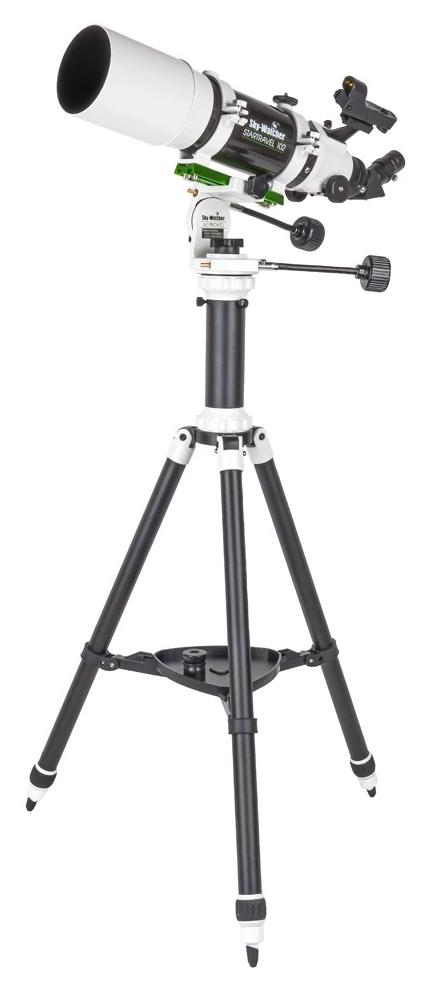
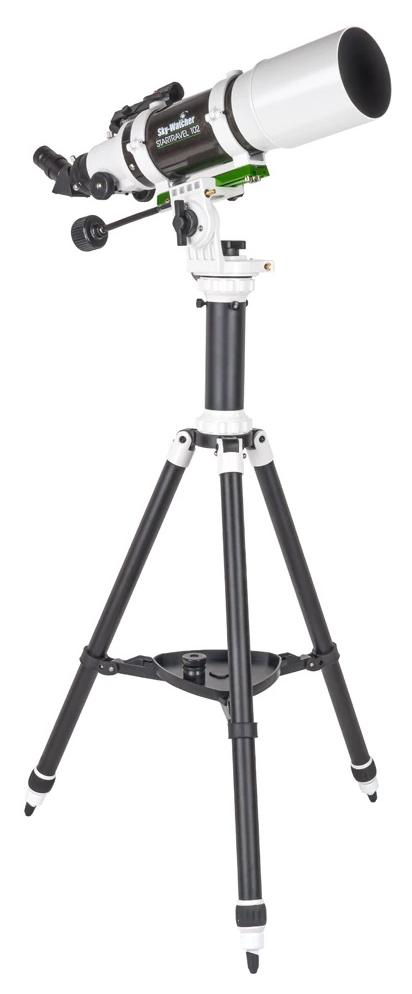
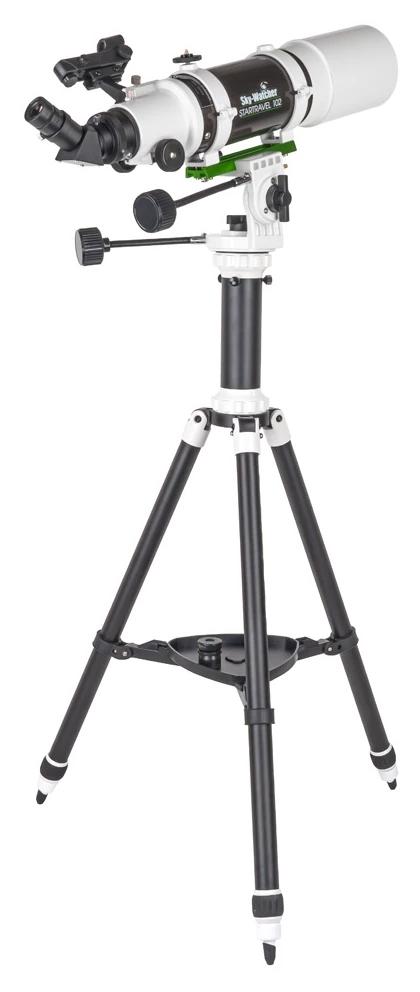
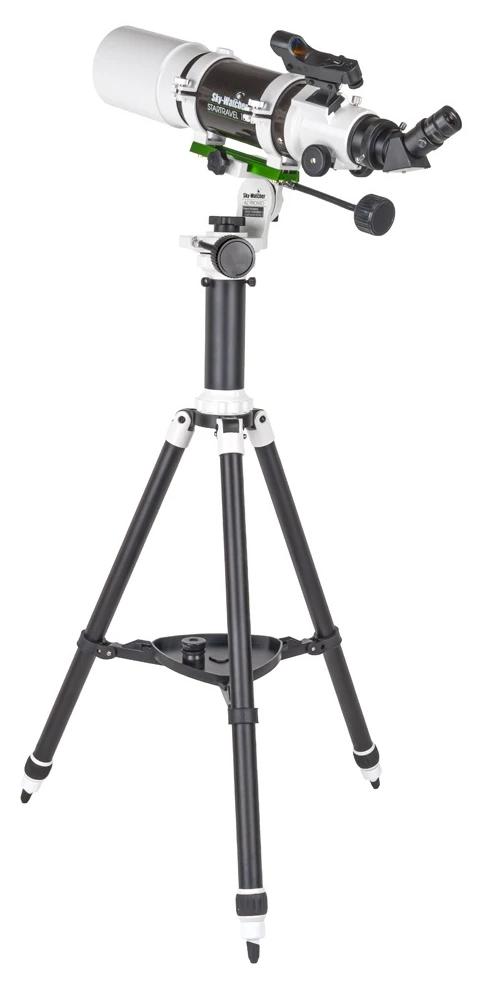
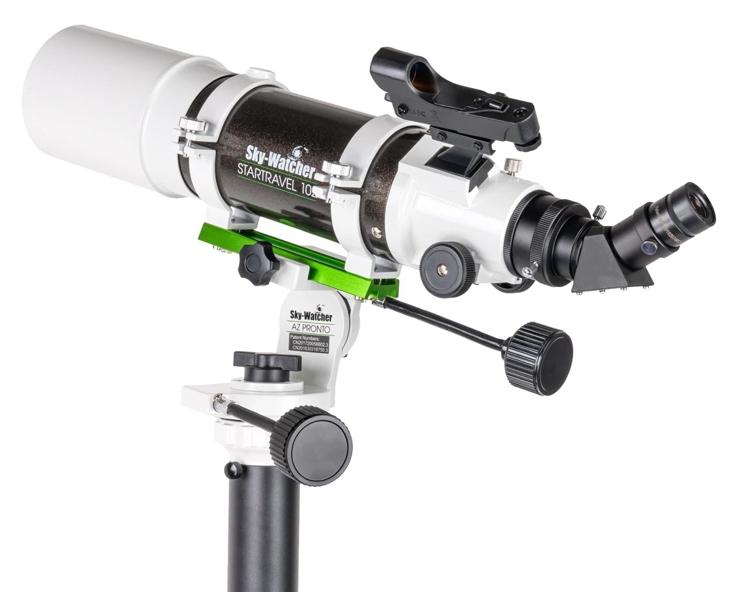
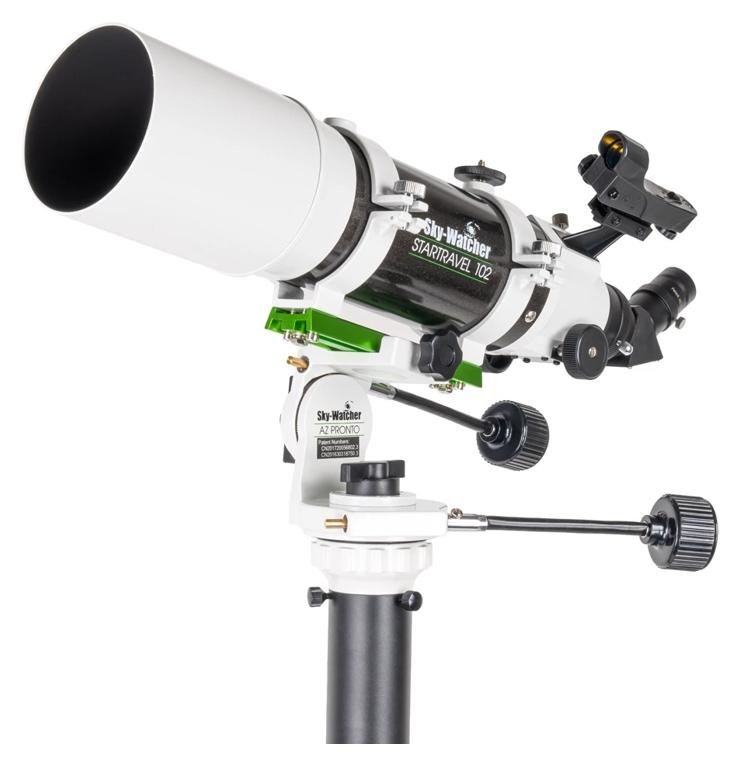
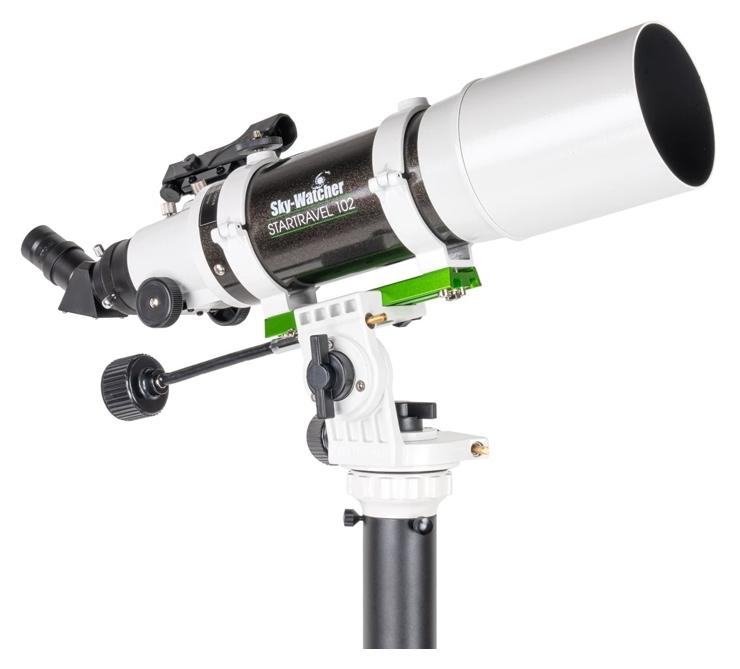
Sky-Watcher BK1025 AZ Pronto achromatic refractor with a lens diameter of 102 mm and a focal length of 500 mm. A large aperture for a refractor and a relatively short focal length make this telescope capable of obtaining a very wide field of view. This makes it an excellent choice for people who want to admire large open clusters, extensive nebulae or entire sections of the Milky Way.
The telescope is quite light, which, combined with its relatively small dimensions, makes it easy to transport or store. This telescope is also a good solution for beginners observing the night sky. The large field of view that can be achieved in this telescope is very helpful in finding objects in the sky.
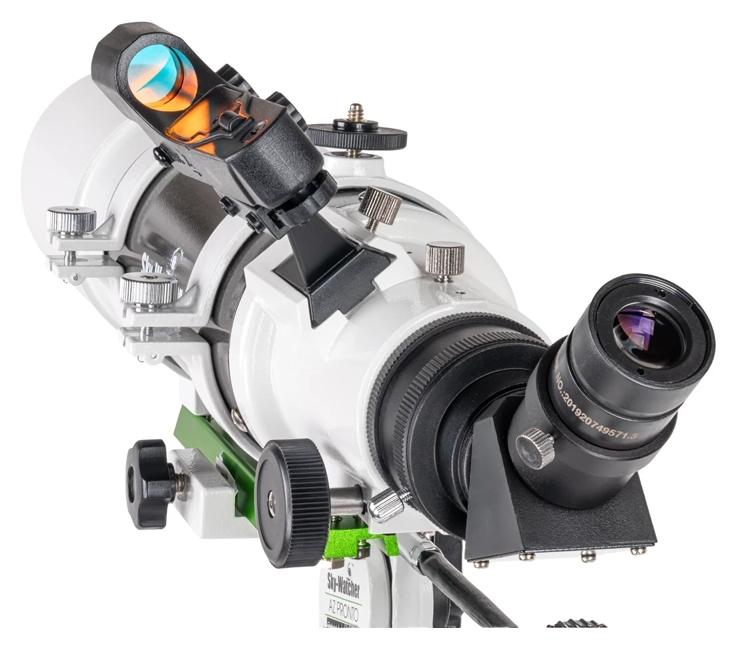
The set includes a Star Pointer finder and clamps with a dovetail that allow you to attach the refractor to the mount. It works well as a small device for beginners, allowing for comfortable observations of the Moon, Sun (when using an appropriate solar filter), or planets. However, this type of telescope will work best in observing large star fields, entire sections of the Milky Way. With appropriate eyepieces, it can provide a field of view comparable to wide-angle binoculars at a typical telescopic range. Due to these types of properties, this telescope can be used to observe comets, especially those with extensive tails. It is very well suited for observing variable stars using the visual method. When using short-focus eyepieces, this telescope will allow you to observe objects on the Moon's disk and also allow you to admire planets in a basic way (here we recommend Maksutov-type designs or refractors with a longer focal length). The design of the telescope also makes it a useful tool for nature observations.
This telescope is a classic, two-element achromatic refractor. This type of system guarantees good brightness of the image received. The telescope collects about 212 times more light than the human eye at night, providing the possibility of observing objects up to almost 12.6 magnitudes (with naked eye visibility up to 6 magnitudes). The size of the lens is also related to the optical resolution, which in this telescope allows for resolving stars that are more than 1.4" apart.
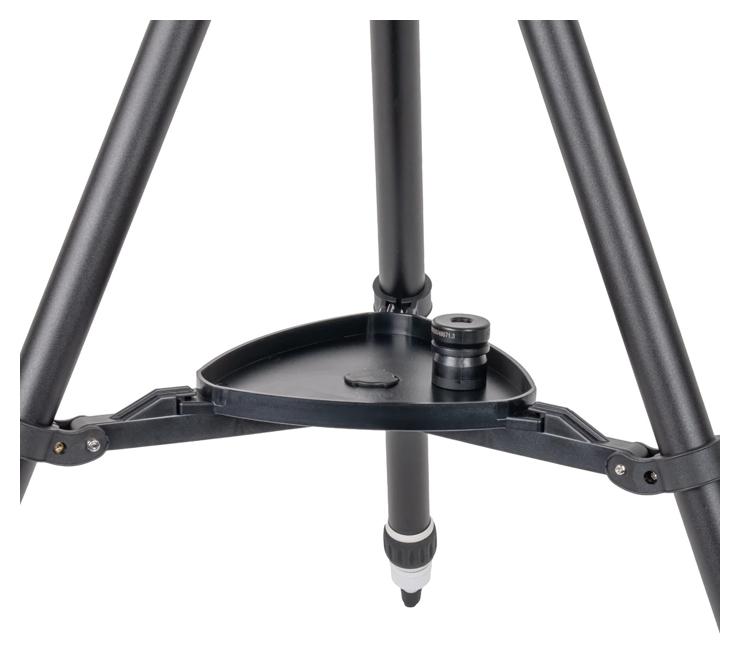
The Sky-Watcher AZ PRONTO is a lightweight and portable altazimuth mount made of aluminum, designed to hold small telescopes weighing up to 3 kg, equipped with micro-motion on both axes. The aluminum telescopic legs of the tripod can be extended and locked in any position using the leg locks. It is supplied with two flexible micro-motion knobs, one for vertical and one for horizontal smooth movement control. The knobs can be set to two different positions on each axis. The mount can also be moved manually around each axis to quickly pan and adjust the height and easily track distant moving objects.
The telescope is equipped with a 2" eyepiece extension tube. The set includes a 1.25" reduction, to which a standard 1.25" prismatic 45 degree attachment is mounted. By default, 1.25" accessories fit the telescope. To install 2" eyepieces, you will need an additional 2" angle attachment - in order to achieve the best possible image quality, we recommend dielectric angle attachments. The standard rack&pinion extension tube is compatible with Sky-Watcher electronic focusers.
- Solar system
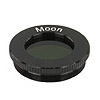
When observing bright objects, it is worth putting a cap with an aperture reduction hole on the lens opening, which will reduce the effects caused by chromatic aberration:
• objects on the lunar surface larger than 2 km
• sunspots and their structure (a lens filter is required for solar observations)
• all planets of the solar system
• phases of Mercury and Venus
• small shield of Mars, polar caps and outlines of continents visible in opposition
• Jupiter's equatorial belts and the Galilean moons
• Saturn's rings and the largest moon Titan
• Uranus and Neptune in the form of stars
• the movement of asteroids against the background of stars
• observations of bright comets
- Stars
• about 1.1 million stars in the entire sky, with a brightness of about 12.6 magnitude
• double and multiple stars separated by an angle of more than 1.4"
• the colors of the brightest stars
- Nebula objects
• almost all objects from the Messier catalog
• hundreds of globular clusters, the largest ones are starting to be broken up into single stars at their edges
• hundreds of open clusters
• brighter nebulae, in many cases structural details
• brighter galaxies, visible spiral arms when observed under dark skies
- Ground observations
A telescope with this type of optics is very well suited for terrestrial observations. The use of a prism diagonal attachment allows the telescope to be used as a very good quality spotting scope with the possibility of taking pictures with a given focal length.
• Telescope optical system: refractor
• Mounting type: azimuth
• Aperture: 102 mm
• Focal length: 500 mm
• Light intensity: f/5.0
• Stellar range: 12.6 magnitude
• Maximum usable magnification: 204 x
• Maximum resolving power (Rayleigh): 1.4 "
• Collective capacity: 212 x
• Tube weight: 2.5 kg
• Tube length: 500 mm
• Tripod type: aluminum
• Assembly control: manual
• Type of eyepiece: rack and pinion
• Focuser diameter: 2 "
• Focuser micro-movements: no
• Mounting rail: Vixen
• Warranty period: 60 months
• 1.25" 45° prism angle attachment
• finder: Star Pointer
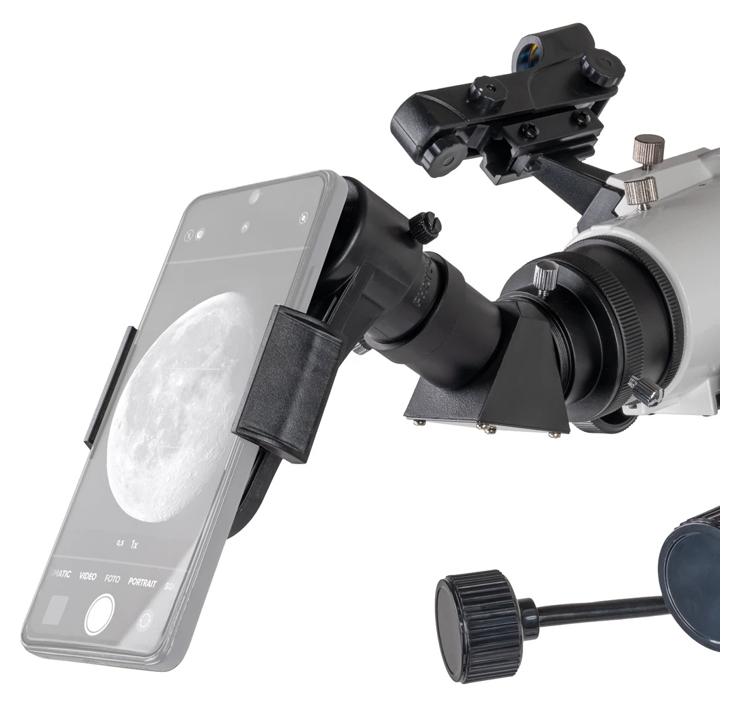
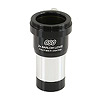
• smartphone adapter
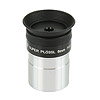
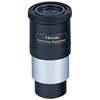
• 1.25" glasses: Photo 20, Photo 10