|
|
 Shop online: Shop online:
● ready for shipping
Shop in Warsaw (qty): 10+
● ready for shipping
Shop in Chorzow (qty):
● not available
|
|
Please help: 6200 or 2400?
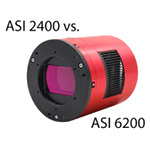
A question that is from time to time asked on forums is "what camera is better, 2400 or 6200, why is the 6200 vastly more popular?".
Several, not really educated, answers appear:
-> the 6200 has better tonal range coz of 16 bit ADC
-> the 2400 has larger well, so better under dark skies
These two are utter trash! The typical non-trash answer, but still overly simplified, is: big reflector, go 2400MC, small refractor, go 6200MX.
Don't get me wrong, this text is meant to offend these answers and their makers, so if you are one of those exquisite thinkers... please read on, I will try to clarify misconceptions and explain the difference to top level customers who still aren't decided yet. Though at that level of commitment they should already know this stuff better than I do. :)
0) The boss
If you are an absolute boss, and want both the MM and MC versions of the camera, then only 6200 is suitable. 2400, afaik, is only available in OSC. So in fact I am mostly comparing 6200MC with 2400MC as there is only one MM version.
1) The pixel
The first difference one immediately notices is the pixel. Almost a 6 micron square for the 2400MC and 3.75 micron for 6200MX. A quick ground school maths gives an area factor of (5.94/3.75)^2 = 2.5.
So ASI2400's pixels are approximately 2.5 times bigger (area-wise). So they collect photons 2.5 times faster? Yes, basically yes. But... the total amount of photons that reach your sensor will be the same, as the sensors are of the same size. The data will be simply sampled and binned differently. We will focus on this more in the upcoming points as it is of utter importance. We will assume that the QE's of both sensors are the same, which is not far from the truth.
Remark: The smaller pixel gives you a smaller imaging scale, which generally is very much appreciated in smaller refractors. There is a simple formula which gives you the focal length for a 1 arcsec/px scale. It says 1"/px_focal length = 206.5 mm/micron * pixel_size. As the pixel sizes are in 1:1.6 ratio, so are the image scales.
-> 1"/px for ASI2400MC at 1225 mm focal length
-> 1"/px for ASI6200MX at 773 mm focal length
For average to good seeing conditions, 0.8"/px to 1.6"/px is considered an optimal sampling scale. You can try to battle undersampling with drizzle, which is more or less giving good results, but isn't as convenient. I have tested the 2400MC with 200 mm focal length (6"/px undersampling) as well as 2000 mm and both can be handled. Oversampling, on the other hand, can be later battled with binning in post processing.
So, though it can be handled, for convenience: 1000+ mm focal length, consider ASI2400, below look at 6200
1a) The filesize
Ofc different pixel sizes yield very different resolutions, for the ASI2400MC it's 24 Mpix which yields a 50 MB file, with the 62 Mpix in the 6200MX cams it's 120 MB per file. You'd think, damn, bigger files and shorter exposures (coz of smaller well)... it's a hassle. But you are wrong again. Only that bit about the bigger file size is true :)
2) The well
The well, as advertised, is 100 ke- for 2400 and 51.4 ke- for the 6200. Which typically makes people think "smaller well". But in 1) we have established the 2.5 area factor, so upscaling to the pixel size of the 2400 the 6200 has 51.4 ke- * 2.5 = 130 ke-. Or, the total well capacity of the sensor is numberOfPixels*pixelWell and 62M*51.4 > 24M*100. In reality it is even more complicated. Let us see...
3) The gain
The interesting heterodyne CMOS architecture nowadays offers "2 in 1" style amplifiers. Commonly called LCG and HCG (low- and high conversion gain).
Typically gain is depicted in e-/ADC units, but equivalently it can be depicted by the usable well capacity. Simply speaking: if gain is "x2" then only "half of the well" works. Looking at the gain diagrams for both cameras we see that with the 2400MC the lowest HCG gain is 140 and for the 6200 it is gain 100.
Do I need to use HCG? Typically for astrophotography -- yes. If you live in atacama and are a pro, or maybe own a f/2 hyperstar or RASA, then you may experiment with LCG, but in that case, U don't need my article and know what you're doing. That is why I will focus on comparing the lowest HCG gains.
3a) The usable well
The effective well for gain 140 in 2400MC is 20 ke-, yielding a ca x5 gain factor. Note that it is not fully sampled by the ADC as it is 14 bit and can store only 2^14 = 16384 levels. The well for the 6200MX at gain 100 is 11 ke-, which also gives a similar x5 factor. Multiplying this by the area factor of 2.5 gives a well of 27.5 ke- in terms of the bigger pixel size. That is ofc as before 30% higher and allows for 30% longer exposure times than the 2400MC@140.
Summary: at lowest HCG the 6200 gives you 30% more exposure time.
4) The ADC bits
So 6200 is better because the ADC has 16 bit sampling! WRONG. First of all to use even 14 bits you need to store 16384 levels, which is below HCG for the 6200 (see 3a). The ASI2400 has unity gain at 158, and can't fully sample the 20 ke- well at gain 140 (lowest HCG). In the case of the 6200: you basically can't fill a 16 bit ADC with 51400 e- levels, because 16 bits can store 65536 levels of info. If you plan to use the camera in high light conditions, you can do it and then you will gain an immense tonal range even for a single shot!
Another one: tonal range is better for 6200MX coz of the 16 bit ADC. WRONG. You will use it at lowest HCG (100), where you can store 11 ke-. The 2400MC at 140 gain can store 20 ke-. It's obvious that bigger pixels have lower resolving power, but higher tonal range.
4a) Tonal range and stacking
So you measure, 3, 3, 4, 4. The average is 3.5 right? But you can't measure .5, you could only measure whole units. Nevertheless, the average has higher accuracy than the measurement. In the same way stacking of properly sampled data improves the tonal range by a couple of bits depending on the amount of data.
5) The glass. Yes, the glass
But come on... what's that about? Who'd worry about anything else than the protective windows being clean. And maybe heated. This is where you are wrong. Many people love uncorrected reflectors (like RC's) for the lack of lenses and other dispersive material. An OSC shot from an RC scope is basically free of chromatic aberration!? Not really, the protective glass transmits the rays at various angles (angles varying from inner ray incidence angle to marginal ray incidence angle). Believe it or not, the effect might be quite small, but noticeable. That is why lower dispersion and lower refraction glass is best to use with protective windows.
Additionally, the anti-reflective coating is really important when using filters and trying to minimise the ghost and halo effects.
So far I have tested that the protective glass in the 2400MC is suitable to be plugged in inside refractors WITHOUT any UV/IR cut filter. That has its downsides as it probably isn't suitable to use with UV or IR imaging, but hey, OSC cams aren't for that anyway. The dream team would be a 2400MC paired with a TEC 140 or FLT 156 with FLAT 68 III for OSC imaging.
I still have no precise information about the type and quality of the window in the 6200MX but I hope I will be able to test this soon and update this guide!
Przemek M.
|