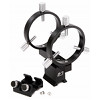
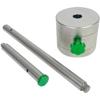
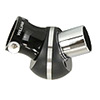
The William Optics FLAT8 Flattener ensures that uniform image quality is maintained - flatness, because the flattener is a "flattener" - both in the center and at the edge of the frame, eliminating the negative influence of the refractor's optical system, as a result of which the sharpness of recorded objects gradually deteriorates with the distance from the center of the frame.
• M4/3
• Sony α
• Nikon
• Pentax
• Canon
• Fuji
• multiplicity: 0.72x
• construction: triplet with air gap
• regulation: yes
• focuser mount: M92 thread
• camera mount: M48 thread
• possibility of mounting a filter: yes, M48 thread
• lens material: Ohara optical glass (Japan)
• anti-reflective coating: yes, full multi-layer coating
• Compatibility with CCD cameras: yes
• Compatibility with CMOS cameras: yes
• filter wheel compatibility: yes
• FLT132: 63.4mm
• FLT156: 60.8mm
• GT102: 67.1mm
• GT153: 60.4mm
• FLT132: 44.4mm
• FLT156: 44.4mm
• GT102: 44.4mm
• GT153: 44.4mm
• William Optics FLAT8 flattener
24 months


It should be remembered that this device is characterized by a constant backfocus value, i.e. the distance from the lens to the primary focus, e.g. the matrix of a digital camera. Generally speaking, both the reduction factor for focal reducers and its increase in the case of Barlow lenses change with the distance from the main focus, so you can easily choose the required value.
However, if we are dealing with flatteners or field correctors, the backfocus value must be precisely defined and cannot be changed. This means that a sharp image can only be obtained when the user sets the correct focal length, which sometimes requires precision of 0.1 mm.
Most of these types of variable focal length accessories have a manufacturer-specified focal length. However, if you can’t find this information in the user manual or on the website, a general assumption is that the typical back-focus value for astrophotography is 55 mm. If your camera is not designed for this value or you are using modified equipment, look at the products listed below that will solve your problem:
elektromy.pl/advanced_search_result.php?keywords=gso+m48