|
|
|
949 zł
|
|
price without VAT: 771,54 zł
|
| |
 Shop online: Shop online:
● not available
Shop in Warsaw (qty):
● not available
Shop in Chorzow (qty):
● not available
|
|
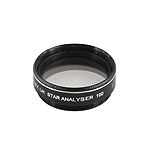
Star Analyzer 100 is an efficient diffraction grating with 100 lines per millimeter. It is mounted in a standard luminaire 1.25 "and thus compatible with most telescopes and accessories.It allows to obtain spectra images of many astronomical objects.Typically, it is used with astrophotographic cameras, but it can also be used for visual observation. • in the luminaire 1.25 "- mounted the same as filters 1.25"
• very simple operation
• hardened and protected optics
• the perfect choice for the start in spectrometry of astronomical objects
• grid: 100 lines / mm
• a prism increasing the grid resolution up to 130 lines / mm is available separately


• a large study on spectrography (in English and French): http://astrosurf.com/buil/spectrographs.htm (access September 2017) Basics of use
Star Analyzer is a diffraction grid mounted in a round housing of a standard filter with a diameter of 31.75 mm. The grid has 100 lines per millimeter and gives a very effective "blaze" (blaze = light energy is reduced to a single spectrum with a high degree of efficiency). This is an affordable price accessory that can be ordered eg at Shelyak.com or teleskopy.pl. The Star Analyzer should be placed at a distance of several to several dozen millimeters in front of the detector plane. In this way, all stars in the field of view will be accompanied by a spectrum. This accessory works instantly and efficiently, giving a low-resolution, training spectrography. The ease of use is even greater when using a digital mirror as a detector because the spectra appear directly in the colors and on the extended field. For detailed technical information about the principles of operation of the grid for the converging beam of the telescope, please go to the special page (further information, mainly in English at http://astrosurf.com/buil/spectrographs.htm).
Example result

Above - a characteristic image obtained by using the Star Analyzer grid.
We have here the neighborhood of the M57 planetary nebula. The nebula is dispersed into its basic monochromatic components (primarily oxygen and hydrogen lines). The star HD175577 at the top is a type M star, strongly red. A composition of six shots after 90 seconds in focus C8, Star Analyzer placed 85 mm in front of the detector. The detector is a Canon EOS350D camera in which the filter has been removed before the infrared cutting die (the filter does not replace anything). The spectral response is therefore extended far in the near infrared.
Quality of the result image
The quality of the spectrum obtained by this type of spectrograph is limited mainly by two factors:
- the quality of the image that the telescope can provide - it depends on the optical quality of the telescope, the precision of focusing, the accuracy of assembly tracking, atmospheric turbulence
- optical system aberrations
Atmospheric turbulences are undoubtedly the dominant factor that worsens the spectral resolution, because the focal length of the telescope exceeds 2 meters. This is the most troublesome parameter - it destroys the scientist part of the content (the results are not repeatable due to changes in the seeing). In our case, we used Celestron 11 (f-2800 mm) to which the Astrophysics focal length reducer was added to reduce the focal length by a factor of about 0.6. The scattering device is placed just before the focal length reducer.
The most important optical aberration is the chromatic coma. You can measure its weight at the points in the diagrams below, obtained using optical calculation software. Here we have the size of the image spots for the three wavelengths, when the Star Analyzer grid is placed 85 mm in front of the detector's surface, the Celestron C8 telescope (f = 2000 mm).

The use of an additional prism for better quality
You can eliminate the chromatic chamber by adding a prism with a small angle at the top of the beam, for example by gluing it to the Star Analyzer grid. Such a prism deflects the light in the opposite direction to the grid. Combining these two optical elements, we obtain GRISM (short for GRID and PRISM). The global result deviation is quite weak because it is due to the prism and this caused by the net compensates partially, as we have already mentioned (in addition, this small angle of inclination so obtained explains the reduction of optical aberrations). On the other hand, the spectral dispersion is practically the same as the dispersion of the mesh itself because the prism itself scatters very little (it has a small top angle).



|