|
|
 Shop online: Shop online:
● not available
Shop in Warsaw (qty):
● not available
Shop in Chorzow (qty):
● not available
|
|
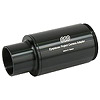
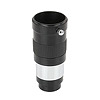
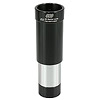
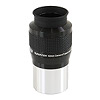
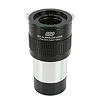
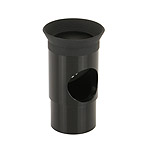
Collimation eyepiece allows to precisely adjust the optics of telescopes in the Newton system and refractors (with the possibility of adjusting the lens in the cell).
Use in lenticular telescopes (refractors)
The Cheshire collimation eyepiece allows you to adjust the refractor's lens so that the images obtained have the highest resolution. High-end telescopes usually have a non-rigid, but adjustable, objective cell. It is worth to use it well and at first, it is easy to collapse your refractor.
• diameter setting: 1.25 "
• length: 69 mm
• recommended for bright telescopes (f / 4 - f / 10)


>> FREQUENTLY ASKED QUESTIONS << Question : How to collimate the refractor? What is the working principle of a Cheshire collimator?
Answer: Newton's telescopes require relatively frequent adjustments. The advantage of refractors is that they rarely require collimation. However, the higher refractor models have adjustable objective objectives and to obtain the highest quality visual images and excellent resolution in photographs you have to take into account the necessity of their collimation.
The most perfect optics test is of course a star test . It can and should be used also after the collimator of the Cheshire eyepiece, to be sure about the precision of the telescope's optical axis alignment.
Since one picture usually translates more than many words, let's see how the images of the medium bright star look like through a properly collimated telescope and with a bad collimation.
THE RIGHT IMAGE OF STARS

THE STARED HEART STAR
WRONG PICTURE OF STARS

THE STARED HEART STAR Cheshire eyepiece allows you to easily collapse the refractor, although, as mentioned earlier, the final opinion about collimation is worth supporting the result of the test (this applies to all collimation methods, collimation with a laser beam included - that's why professionals they often use an "artificial star" - a small enough, far-reaching source of light).
However, collimation at night, "on the stars", is not very comfortable, it's good to start collimating the refractor just from the use of the collimator Cheshire. To do this, insert the collimation eyepiece directly into the eyepiece extractor (the caisson may break the collimation!) And direct the side opening with the silver-plated surface with daylight or artificial light. Now, looking through the eyepiece (just like an ordinary eyepiece, into a small hole in the eyepiece), you'll see one or more "donuts" similar to those below, usually slightly overlapping, in the middle of the field of view. If you see more than one "bud with a hole", you must adjust the lens frame so that the "bunches" merge into one. Finally, the "bud" should be one, in the middle of the field of view determined by a double cross of threads in the eyepiece, with an even, pale blue color, circular, with one circular concentric gap to the edge and a black circle in the middle, corresponding to the beam falling on the hole (soon, when we finally get out of it, we will show pictures here from the collimator Cheshire).
If you obtained the correct image, you can set your angle connector and check that it does not affect the collimation. Some of the strips can have a crooked prism or mirror that will negatively affect the quality of the images obtained. THE PERSONAL IMAGE IN CHESHIRE

ONE PIECE WITH HIT, CENTRAL, SYMMETRICAL
THE WRONG PICTURE IN THE CHESHIRE SCOT

MORE THAN ONE PIECE WITH A HOLE
|