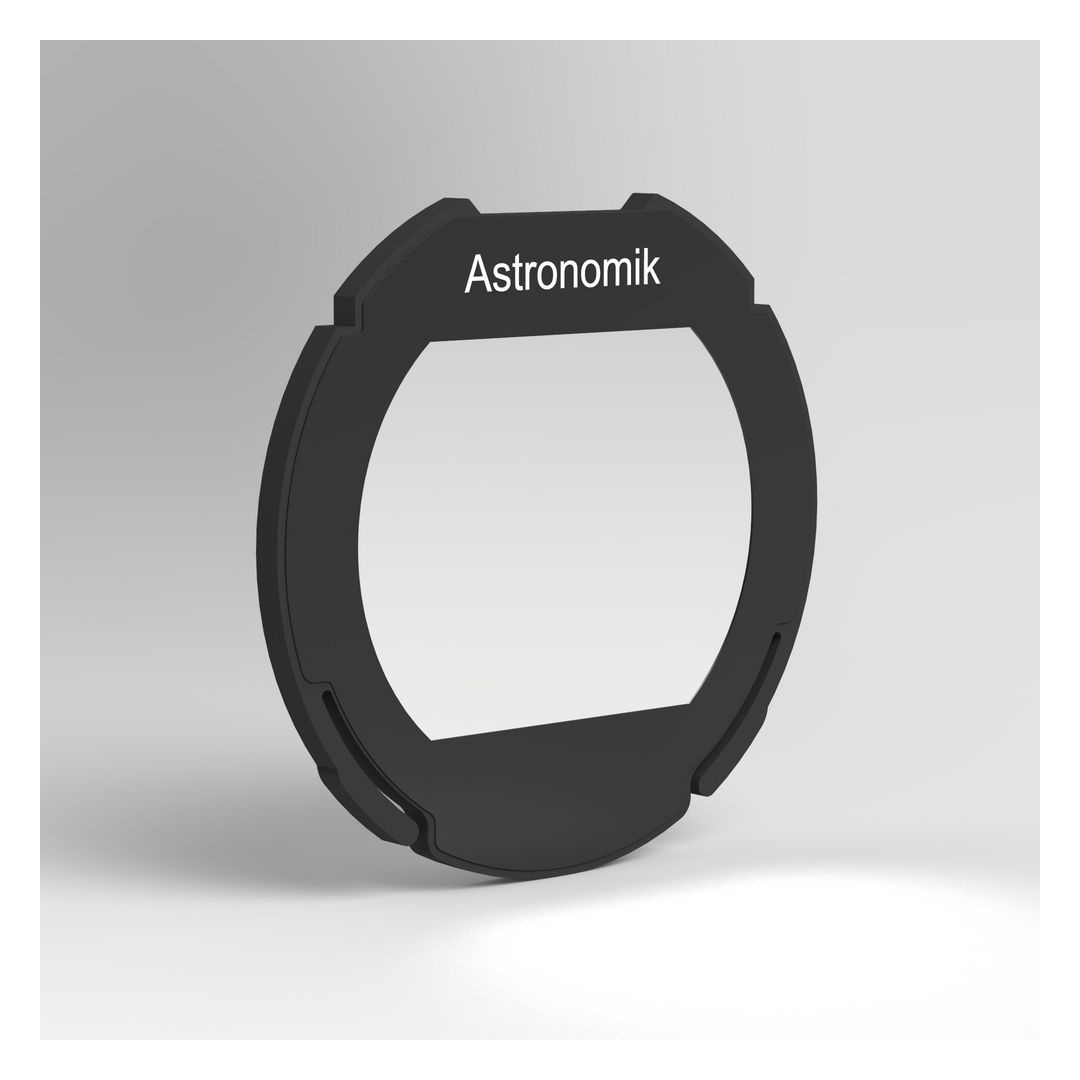
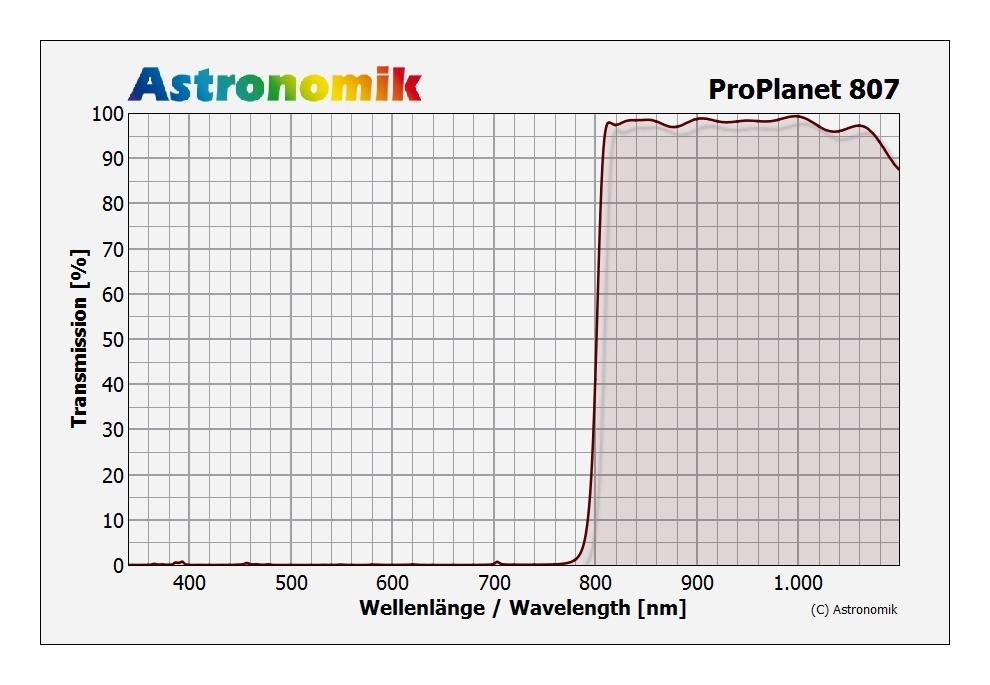
Astronomik ProPlanet 807 XT Clip-Filter EOS APS-C (Astronomik, SKU: 10203101) is a near-infrared pass filter transmitting wavelengths above 807 nm for lunar and planetary imaging. Imaging in this range can reduce the effects of atmospheric turbulence compared with visible-light imaging. The Clip-Filter EOS APS-C version is designed to fit inside a compatible camera body.
• suitable for imaging planets, especially Mars, and the lunar surface
• recommended telescope aperture: about 250 mm or larger
• darkening of the sky background that enables imaging even after the sky has brightened at dawn
• requires an IR-sensitive camera or a Full Spectrum/MC-modified camera; a camera's standard IR-cut filter limits its use
• intended for photography; the filter is unsuitable for visual observation
• installation and removal of the Clip-Filter without modifying the camera body or using additional tools
• thin substrate in the XT version to reduce edge aberrations with wide-angle lenses
• optically polished glass and durable coatings resistant to scratches and humidity
• one Astronomik filter in the specified version, SKU: 10203101
• protective storage box
• manufacturer: Astronomik
• manufacturer SKU: 10203101
• filter type: ProPlanet 807 IR long-pass
• transmission cut-on: 807 nm
• transmission: over 97% in the 807–1100 nm range
• blocked range: 350–790 nm
• mounting: Clip-Filter EOS APS-C
• compatible Canon EOS cameras: 7D, 7D Mark II, 20D, 20Da, 30D, 40D, 50D, 60D, 60Da, 70D, 77D, 80D and 90D
• compatible Canon EOS cameras: 100D, 200D, 250D, 300D, 350D, 400D, 450D, 500D, 550D, 600D, 650D, 700D, 750D, 760D, 800D and 850D
• compatible Canon EOS cameras: 1000D, 1100D, 1200D, 1300D, 1500D/2000D and 4000D/3000D; also the regional Rebel and Kiss equivalents of the listed models
• additional application: EOS M cameras when the filter is installed in the original Canon EF-EOS M adapter
• not compatible with original Canon EF-S lenses or EOS-1D and EOS 5D bodies
• cell: black-anodised aluminium
• version: XT
• country of manufacture: Germany
The filter uses infrared light to record lunar and planetary detail with reduced effects of seeing.