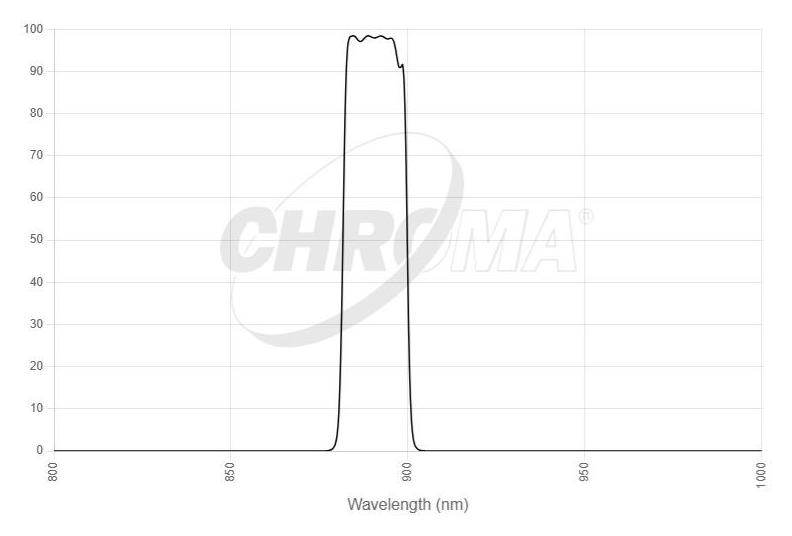
Chroma Jovian Methane 65x65 mm unmounted filter (Chroma Technology, SKU: CT-27012-65X65) is a specialised methane-absorption-band filter designed for imaging planetary atmospheres. It transmits a narrow near-infrared range centred at 889 nm, corresponding to a strong methane absorption band. Atmospheric structures containing large amounts of methane are recorded as darker, increasing the contrast of details between individual cloud layers and regions within the atmospheres of giant planets.
• specialised characteristics designed for imaging the methane absorption band
• central wavelength of 889 nm within the near-infrared range
• FWHM bandwidth of 18 nm
• transmission of at least 96% at a wavelength of 889 nm
• increased contrast between atmospheric structures containing different amounts of methane
• application in imaging Jupiter, Saturn and other planets with methane-containing atmospheres
• durable coatings applied using reactive magnetron sputtering
• primary filter coating on the front surface and an anti-reflection coating on the rear surface
• 65x65 mm format intended for compatible filter wheels and optical trains
• one Chroma Jovian Methane 65x65 mm unmounted filter
• manufacturer: Chroma Technology
• model: Jovian Methane
• catalog number: 27012
• SKU: CT-27012-65X65
• type: methane-absorption-band filter for planetary imaging
• spectral range: near-infrared
• central wavelength: 889 nm
• FWHM bandwidth: 18 nm
• transmission at a wavelength of 889 nm: ≥96%
• filter dimensions: 65 × 65 mm
• filter shape: square
• cell: none, unmounted filter
• optical substrate thickness: 3.0 mm
• optical construction: single glass substrate
• coating type: durable magnetron-sputtered coatings
• rear-surface coating: anti-reflection AR coating
• edge finish: blackened
• surface accuracy: λ/4 or better
• transmitted wavefront: better than 0.25 wave per inch
• compatible detectors: CCD and CMOS cameras sensitive to near-infrared radiation
• recommended optical system: f/4 or slower
The narrow transmission band enables differences in methane absorption to be recorded, revealing structures within the atmospheres of giant planets that may remain difficult to distinguish in conventional visible-light images.