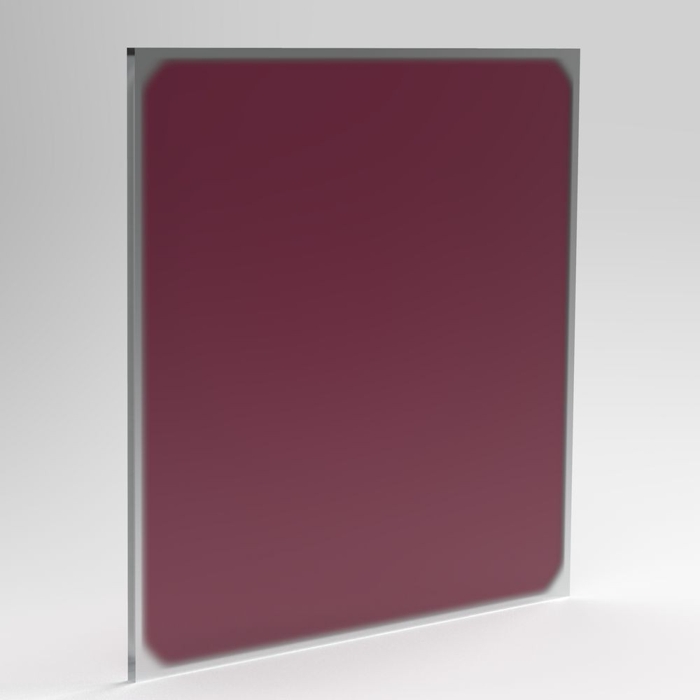
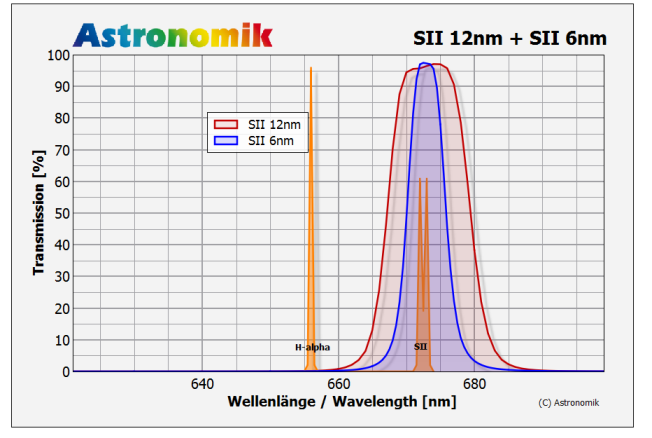
Astronomik SII 12 nm CCD Filter 50 × 50 mm, unmounted (Astronomik, SKU: 10216541 / 8h00ho) is a narrowband filter designed for imaging sulfur-emission nebulae from both light-polluted and dark observing sites. It significantly increases contrast between objects emitting at the SII lines (671.7 nm and 673.0 nm) and the sky background.
The Astronomik SII filter effectively blocks emission lines from artificial light sources such as sodium (Na) and mercury (Hg) lamps, all natural airglow lines and most disturbing moonlight. This results in a darker background and improved visibility of faint nebular structures.
With a 12 nm full width at half maximum (FWHM) and very high transmission, the filter passes the relevant sulfur signal while blocking nearly all unwanted wavelengths from ultraviolet (UV) to infrared (IR).
In areas with low light pollution, the image background is often limited by the sensor’s dark current rather than sky brightness. Under such conditions, further narrowing the bandwidth (e.g. 6 nm or 4 nm) does not necessarily reveal additional object detail, while it may increase exposure and guiding demands.
Astronomik narrowband emission-line filters are among the most effective tools for capturing deep-sky images under challenging conditions, especially in urban skies or when the Moon is present. An H-alpha filter is usually the first step for recording red hydrogen regions, while an OIII filter expands imaging options by capturing green/blue structures typical for planetary nebulae, star-forming regions and supernova remnants.
Adding an SII filter completes the set for imaging in the HSO (H-alpha, SII, OIII) palette, often referred to as the “Hubble palette”, producing striking false-color emission-line images.
4 nm and 6 nm filters are particularly useful for very heavy light pollution, star-rich Milky Way regions (typically fewer stars in the frame) and cameras with extremely low dark current. The 12 nm version is often more universal for typical CCD/CMOS cameras and is frequently preferred for cameras with integrated guiding sensors because it usually shows more guide stars.
Both MFR and MaxFR coatings provide excellent UV–IR blocking, extremely high contrast, minimal scattered light, no halos and sharp star images.
MFR:
• 12 nm: f/3 to f/∞
• 6 nm: f/4 to f/∞
• 4 nm: f/4.5 to f/15
MaxFR is optimized for very fast optical systems:
• 12 nm: fully usable from f/1.7 to f/6 and about 85% of maximum transmission at f/1.4
• 6 nm: fully usable from f/2.2 to f/6 and about 90% of maximum transmission at f/2
• 4 nm (MaxFR): currently under development
• guaranteed transmission > 90% (12 nm / 6 nm / 4 nm) at both SII lines (671.7 nm and 673.0 nm)
• typical transmission: 96% (12 nm) and 93% (6 nm and 4 nm)
• format: 50 × 50 mm, unmounted
• glass thickness: 1 mm (except OWB Type 3 and XT filters)
• finely polished optical glass free of internal stress and bubbles
• extremely scratch-resistant, durable coating; fully resistant to humidity and aging
• Astronomik MFR coating
• parfocal with other Astronomik filters
• diffraction-limited performance
• optimized transmission ranges
• supplied in a high-quality durable filter box
Astronomik filters are designed to preserve your optical system’s resolution and contrast. Each filter undergoes strict quality control, and narrowband emission-line filters are individually measured with a PerkinElmer spectrophotometer to verify compliance with the published specifications.