The combination of great optics, reliable and easy-to-use GOTO system and reliable mechanics while maintaining a low weight - these are the features of the Orion StarSeeker IV series telescopes.
StarSeeker telescopes are a stable azimuth mount with the GO-TO SynScan search and tracking system. In its latest version, the telescope is equipped with a WiFi module that allows you to connect and control the assembly using a dedicated application. Moreover, the assembly was equipped with two encoders installed in two axes. Thanks to this, after roughly pointing the telescope to the desired part of the sky by hand, the drive can immediately go to the precise indication of a specific object that is the target of observation.
The mounting head has a built-in compartment of 8 AA batteries 1.5 V rechargeable batteries, thanks to which the telescope can operate away from the 230 V mains. Of course, you can also connect a 230 V power supply (available separately) .
The StarSeeker IV assembly is used not only in observational astronomy, but also in simple astrophotography and time-lapse photography .
The StarSeeker IV series includes several types of optical instruments:
• 80 mm achromatic refractor
• Maksutow-Cassegrain 102, 127, 150 mm
• Newtonian reflector 114, 130, 150 mm
Due to the high brightness, the telescope is especially recommended for observation of nebulae objects. This model will also prove useful when observing planetary objects as well as the craters of the Moon. The main advantage of this telescope is a large 150 mm parabolic mirror, which is the most important element of the telescope, which determines what and how we can observe. This telescope collects over 450 times more light than the human eye at night, providing the ability to observe objects up to over 13 stellar sizes. The size of the mirror is also related to the optical resolution, which in this telescope allows it to separate stars that are not less than 0.77 "apart from each other.
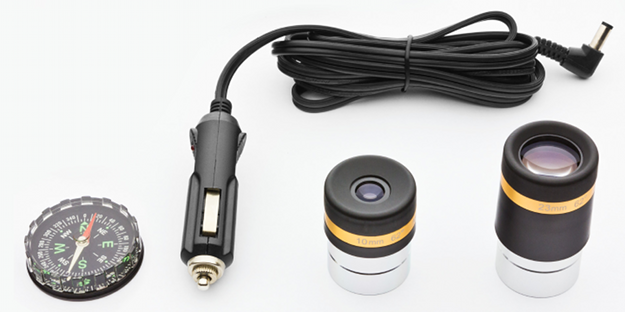
The telescope is equipped with an eyepiece extractor that allows the use of 1.25 "eyepieces. The set includes two aspherical eyepieces with a field of view of 62 °.
The StarSeeker 150 Newton telescope is the first telescope that can be successfully used in the science of planetary astrophotography, thanks to a simple azimuthal assembly with a computerized drive in both axes, which has a load capacity sufficient to lift the tube f / 5 optical system by Newton and DSLR body. The extractor has a T-2 thread for connecting the optional T-ring and the SLR body.
The Solar System
objects on the moon's surface larger than 1-2 km in size; sunspots and their structure, visible photosphere granulation; all planets of the solar system; the phases of Mercury and Venus; Mars shield, polar caps in periods of opposition; several zones of Jupiter belts and Galilean moons; the rings of Saturn with a Cassini gap, a belt in the atmosphere and several smaller moons of the planet; Uranus and Neptune are visible as clearly blue stars; the movement of asteroids against the background of stars; observations of many fainter comets, visible structure of brighter comets
The stars
about 2.7 million stars across the sky, binary and multiple stars separated from each other angularly more than 0.9 ", colors of many stars
Nebulae objects
all Messier directory objects; hundreds of globular clusters, in many cases partly broken up into individual stars; hundreds of open clusters with many visible differences in structure; several dozen nebulae, including first details, rich details of bright nebulae; dozens of galaxies with subtle details of structures, shape and angular position of the disks; visible structure and structure of many planetary nebulae; visible remnants of supernovae
The Newton system telescope is not intended for terrestrial observations, but the image can be "straightened" - for this purpose, use the so-called straightening lens, thanks to which we will reverse the image to natural (straight). There are also straightening glasses on the market - they work on the same principle.
OFFERED TELESCOPIC LETS START OBSERVATIONS IN THE FIRST WEATHER NIGHT - INCLUDES ALL NECESSARY ACCESSORIES
moon
planets
clusters
nebulae
control from PC
• optical system: Newton's reflector
• 150 mm objective lens diameter
• focal length: 750 mm
• lighted: f / 5
• optics quality: diffraction-limited
• resolving power: 0.77 arc seconds
• minimum useful magnification: 21x
• maximum useful magnification: 300x
• star range: 13.5 mag
• assembly: steel tripod φ = 31.75 mm, GOTO AZ head
• built-in WiFi module that allows you to connect and control the assembly using a smartphone, e.g. through a dedicated SynScan application
• tracking speeds: solar, lunar, stellar
• power supply: 8x AA (1.5 V, battery compartment built into the head) or 12 V DC
• mounting the tube for assembly: standard dovetail in the Vixen standard
• the system of double encoders allows for manual shifting of the mounting without "losing" the mounting position
• destiny: observation and photographing of planets, observation of brighter nebulae objects
• 1.25 "focusing system, Rack-and-pinion
• allows you to connect accessories: 1.25 "
• length of the optical tube: 61.5 cm
• weight of the optical tube: 3.8 kg
• total weight of the telescope ready for observation: 10.1 kg
• telescope
• foldable steel tripod
• StarSeeker IV head with WiFi module for assembly control
• aspherical eyepiece 60 ° 1.25 "10 mm (magnification 75x)
• aspherical eyepiece 60 ° 1.25 "23 mm (magnification 33x)
• 5x24 EZ Finder II hybrid optical and projection finder
• table-strut
1 year