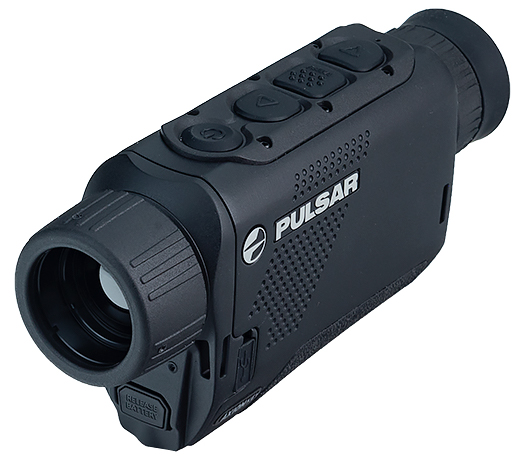
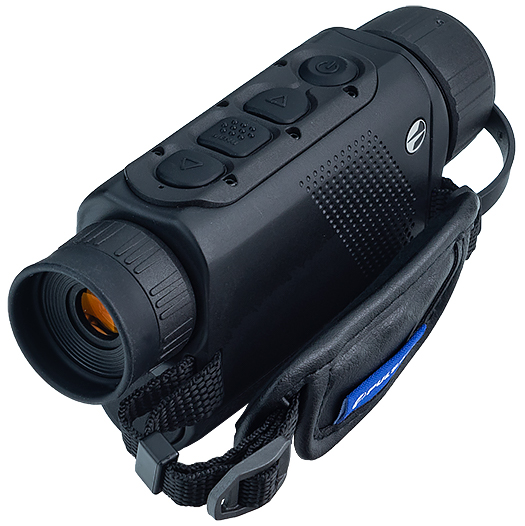
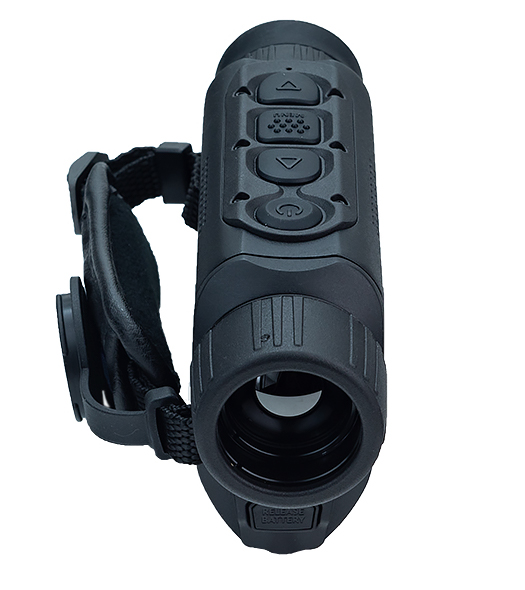
Axion observation thermal imaging devices are a group of completely new devices created as a result of developing the design of Pulsar Lite thermal imagers. Miniaturized, light and economical, with surprisingly good performance. Axion thermal imaging devices are pocket-sized designs that can easily fit in the hand, with a size comparable to a typical laser rangefinder. Equipped with XM sensors with a resolution of 320x240 pixels, which thanks to their special properties obtain a good range and magnification even with relatively modest lenses.
Axion Key XM30 is the simplest and cheapest version of the thermal imager designed for terrain observation. It does not have an image recorder and a WiFi module, however, it allows for trouble-free observation of objects at a distance of up to 1200 meters, which is a result almost three times better than in the case of Lite thermal imaging devices produced so far. The Axion Key thermal imager is equipped with an LCOS display with a resolution of 960x720 pixels, adapted to work in temperatures from -10 to +40 degrees. The whole thing is closed in a light magnesium housing, completely waterproof (protection class IPX7), the thermal imager weighs 250 g. Axion is powered by an APS3 battery with a capacity of 3200 mAh and can work non-stop for over 4 hours.
• name: Pulsar AXION Key XM30, catalog number 77425
• minimum magnification: 2.5x
• maximum magnification: 10x
• digital zoom: 4x
• range of observation: 1200 m
• lens: 30 mm f / 1.2
• optical construction: monocular
• field of view: 7.8 - 5.9 °, depending on the magnification
• hand out matrix: uncooled 320 x 240 pixels, 12 µm
• matrix refresh: 50 Hz
• display: 960 x 720 pixels, LCOS, 8 color palettes
• water resistance class: IPX7
• power supply: microUSB 5 V, battery pack APS3 (included, working time> 4 h)
• dimensions: 143 x 41 x 69 mm
• weight: 250 g
3 years
>> FREQUENTLY ASKED QUESTIONS << Question : What is the difference between a night vision device and a thermal imager?
Answer: The night vision device enhances the visible light (380 - 780 nm) and the light that is slightly near infrared. The thermal imager is sensitive to electromagnetic waves of greater length, of the order of a few - several µm, that is several dozen times greater in length. The EM waves, which a typical thermal imager is sensitive to, correspond to thermal (thermal) radiation. The night vision requires light that can amplify (that's why in full darkness we need IR emitters), the thermal vision device also works in complete darkness, in fog, smoke, etc. The advantage of night vision, apart from simply different imaging and in connection with with this different perception of detail, there is higher resolution and lower price. The advantage of thermovision is work in all conditions and easy detection of heat sources, which is of fundamental importance in rescue, and is useful, among others. Hunting, property protection, sea navigation, nature observation.