|
|
|
2580 EUR
|
|
price without VAT: 2098 EUR
|
| |
 Shop online: Shop online:
● ready for shipping
Shop in Warsaw (qty): 1
● ready for shipping
Shop in Chorzow (qty):
● not available
|
|
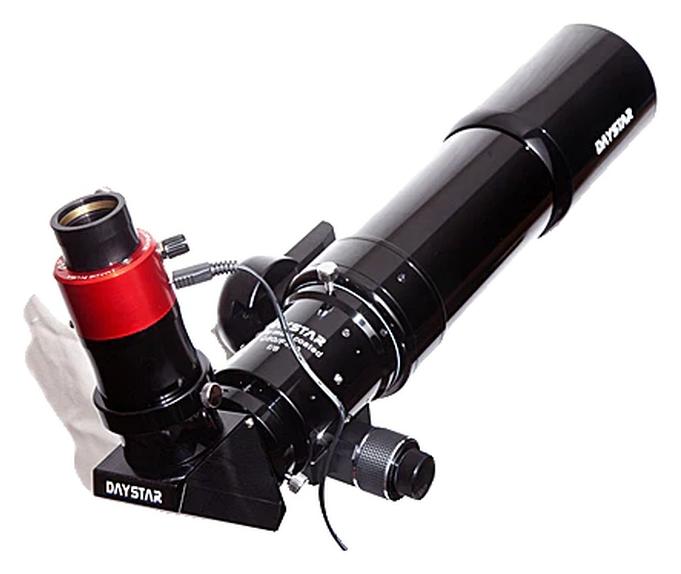
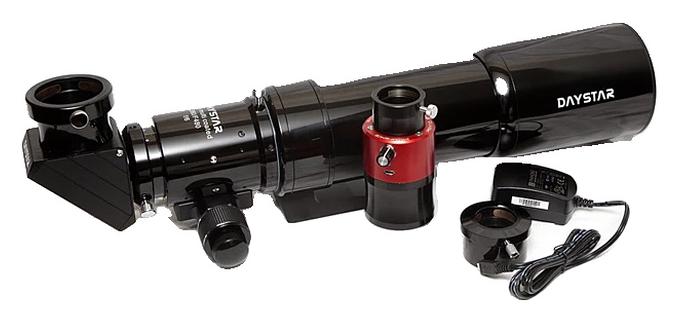
DayStar 80 mm F/6 achromatic telescope with Quark H-alpha Chromosphere filter – bundle (SKU: DSZ4C80B) is a complete solar observing package that can also be used as a nighttime telescope. The set includes an 80 mm F/6 achromatic refractor, the DayStar Quark Chromosphere H-alpha solar filter, and a 2" dielectric mirror diagonal. With its all-in-one design, the Quark filter converts a standard refractor into a hydrogen-alpha solar telescope, allowing observation of chromospheric features such as filaments, plages, and larger prominences.
• complete H-alpha solar observing bundle
• 80 mm F/6 achromatic doublet refractor
• DayStar Quark Chromosphere solar filter with 0.3–0.5 Å bandpass
• allows observation of solar surface detail and prominences
• integrated 4.2× telecentric barlow lens in the Quark
• compatible with refractors of F/4 – F/8 focal ratio
• works with standard 1.25" and 2" diagonals
• USB power supply 5 V / 1.5 A with AC adapter 110–240 V
• tuning knob allowing ±0.5 Å bandpass adjustment
• LED indicator for power, warming, ready and fault status
• no ERF filter required for refractors up to 80 mm aperture
• telescope can also be used for nighttime astronomical observations
• DayStar 80 mm F/6 refractor telescope (model 480E)
• DayStar Quark Hydrogen-Alpha Chromosphere filter (DSZ4C)
• 2" 90° dielectric mirror diagonal 99% (DMFR5)
• aluminum carrying case
• optical design: achromatic refractor doublet
• aperture: 80 mm
• focal length: 480 mm
• focal ratio: F/6
• optical coatings: fully multi-coated
• focuser: 2" hybrid Crayford / rack & pinion with microfocuser
• H-alpha filter: DayStar Quark Chromosphere
• bandpass: 0.3–0.5 Å
• integrated telecentric lens: 4.2×
• blocking filter aperture: 12 mm
• clear filter aperture: 21 mm
• power supply: USB 5 V / 1.5 A
• AC adapter: 110–240 V
The DayStar 80 mm Solar Bundle provides an easy way to start observing the Sun in narrowband H-alpha while still allowing the telescope to be used for regular nighttime astronomy.
|