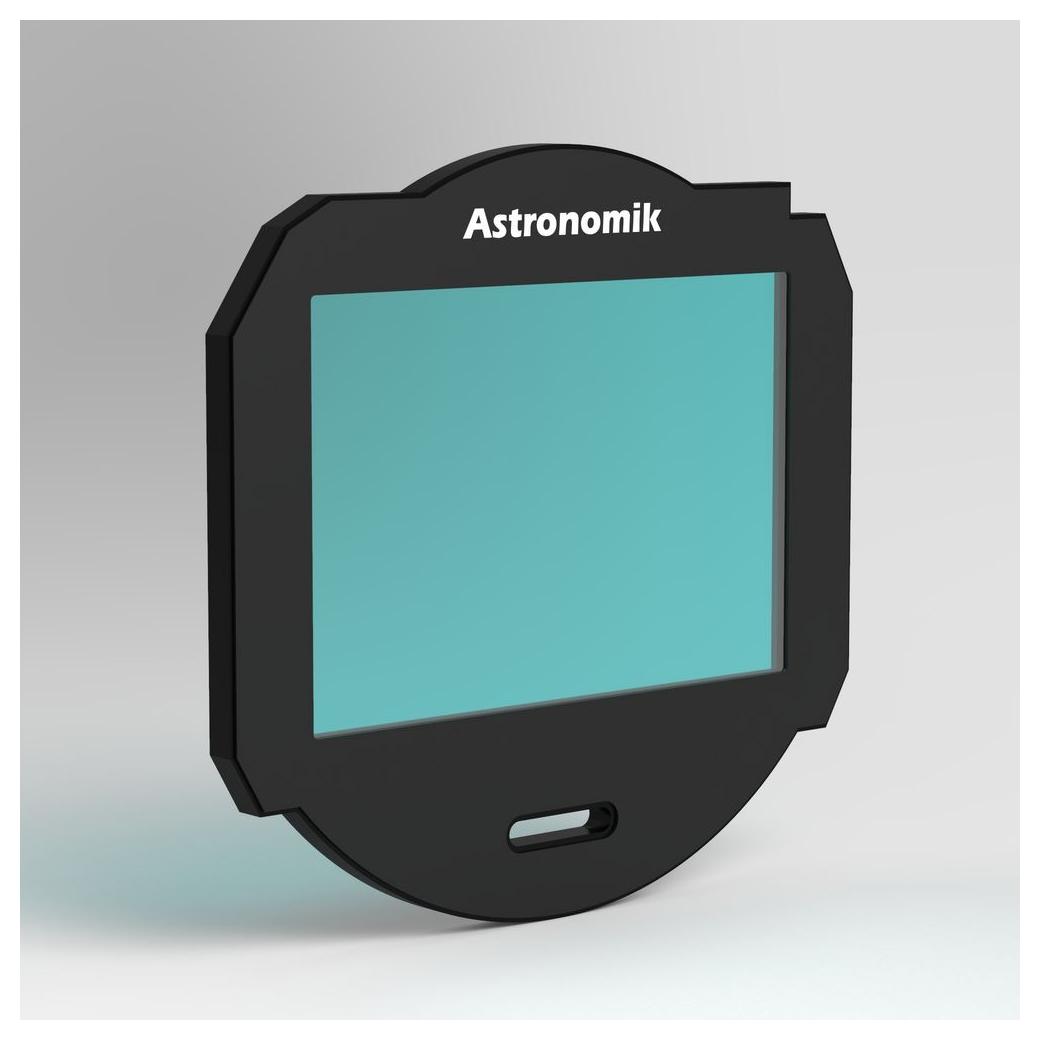
Astronomik CLS-CCD Clip-Filter Nikon Z XL (Astronomik, SKU: 10213083) is a light-pollution filter with integrated infrared blocking. It increases the contrast of deep-sky objects against the background and can be used with cameras that lack their own IR-cut filter.
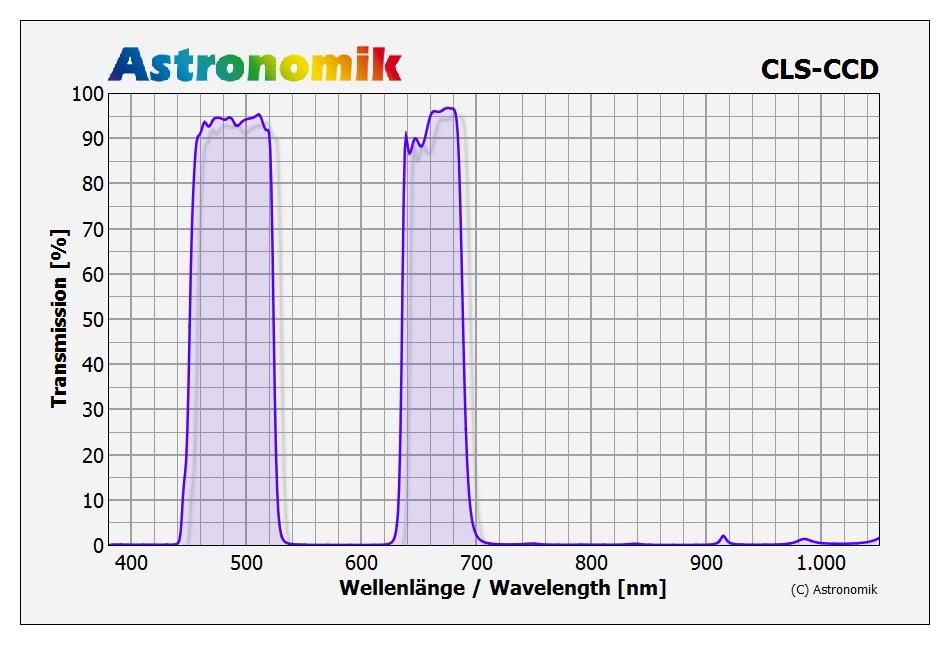
The filter suppresses sodium and mercury lamp emission lines while retaining bands containing H-beta, OIII and H-alpha. It is broader than UHC and therefore dims stars less. It can serve as a luminance filter for emission-line objects. Despite the CCD designation, it is also suitable for CMOS sensors; colour balance depends on the camera and requires calibration.
The Clip mount places the filter inside a compatible camera body, in front of the sensor. This allows the same filter to be used with different compatible lenses or a telescope and reduces dust settling on the sensor. The correct version must be selected for both the camera model and the lens.
• integrated IR blocking for cameras without their own infrared cut-off
• suppression of sodium and mercury lighting emission lines
• broader passbands than UHC, with less stellar dimming
• can record luminance data for emission-line objects
• mounting inside a compatible camera, in front of the sensor
• durable coatings resistant to scratching and moisture
• filter: Astronomik CLS-CCD Clip-Filter Nikon Z XL
• protective filter box
• manufacturer: Astronomik
• manufacturer product code: 10213083
• transmission bands: 450–520 nm and 640–690 nm
• transmission: 95% at 486 nm, 496 nm and 501 nm; 97% at 656 nm
• infrared blocking: integrated
• focal ratio range: f/1.8–f/15
• mount: Clip-Filter Nikon Z XL
• compatible bodies: Nikon Z5, Z6, Z6II, Z6III, Z7, Z7II, Z8, Z9, Zf
• incompatible: Nikon APS-C cameras and Nikon Z TC-2.0x teleconverter
• glass thickness: 1 mm
• material: finely polished optical glass
• optical quality: diffraction-limited
• coating resistance: to scratching, moisture and ageing
• parfocality: with standard Astronomik filters using 1 mm glass
Combining light-pollution suppression with IR blocking simplifies filter selection for an astronomical camera.