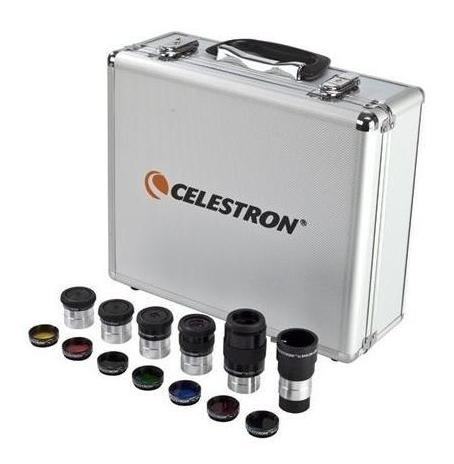
A set of essential filters and 1.25" eyepieces from Celestron to expand the observing capabilities of the telescope.
• 5 Celestron Plössl eyepieces with a diameter of ø=1.25": 4-element optics with a 52° (52-degree) apparent field - eyepieces provide a sharp and clear image. All are multi-coated to improve contrast and image resolution, eyepiece focal lengths: 6 mm, 8 mm, 13 mm, 17 mm and 32 mm. Together with the Barlow lens, this gives the equivalent of as many as 10 eyepieces.
• 2x Barlow lens complementing Plössl eyepieces, maximizing the usability of the set in terms of selecting magnifications. Similarly to the eyepieces, the lens is covered with MC anti-reflective coatings.
• 6 color filters with a diameter of ø=1.25": yellow (#12), orange (#21), red (#25), light green (#56), green (#58A), intermediate blue (#80A) and a gray lunar filter also with a diameter of ø=1.25" - combining the appropriate focal length of the eyepiece with the filter can significantly improve the amount of details visible on the surface of the observed object
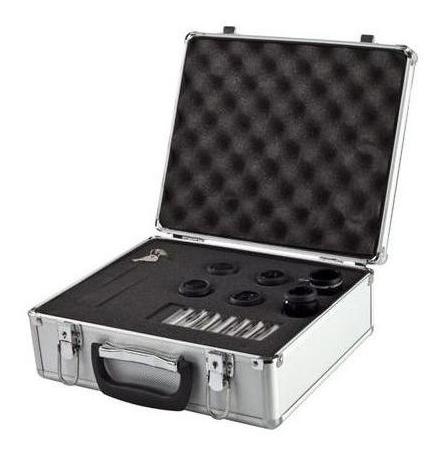
• an aluminum case that will allow you to transport your set comfortably and safely.
Sky-Watcher yellow #12 color filter designed for observing Solar System bodies. Designed for ø=1.25" mount. The yellow filter reduces blue color, increases contrast between dark areas and bright desert regions when observing Mars. Improves contrast for telescopes larger than 10" when observing the Moon. It can also be useful for observing the planet Venus.
Recommended uses for this filter: Moon - very useful for improving the contrast between surface features in 6" and larger telescopes, with or without a polarizing filter. Mercury - darkens the Earth's sky during daytime viewing to bring out the rarely seen subtle surface albedo differences. Venus - darkens the Earth's sky during daytime viewing to make phases more visible. Mars - increases the contrast of polar caps, frosted areas, low clouds, and dust storms relative to ochre desert areas. Also sharpens the edges of yellow dust clouds. Jupiter - highlights belt structure and brings out winging and detail in the polar regions. Saturn - improves the structure of atmospheric belts and highlights blue-toned polar regions. Comets - can be applied to filter #38A to improve the contrast of orange sodium D lines in comet gas tails in 10" and larger telescopes. Improves the resolution of the head image and dust tails in 10" and larger telescopes. Solar observations - it is used if we want to obtain proper color reproduction when using a solar filter made of AstroSolar® mylar foil from Baader Planetarium. Filter transmission Tmax=46% (OD=0.3).
Red color filter #25 designed for observing bodies of the Solar System. Designed for mounting in the ø=2" standard. The red filter strongly reduces blue, green and to some extent also yellow. It can be useful for observing bluish structures in the atmosphere of Jupiter. Improves the visibility of polar caps on Mars. When observing planets during the day, it clearly darkens the brightness of the sky, improving the contrast.
DO-GSO dark green #58 color filter designed for observing Solar System bodies. Designed for ø=1.25" mount. The dark green filter strongly cuts off blue, red and yellow light. It works well when observing the Moon and very bright comets, where it allows you to see elements glowing in the green emission line of oxygen.
Recommended uses for this filter: Moon - very useful as a lunar filter increasing contrast against a dark sky background in 6" and larger telescopes. Mercury - can facilitate observations of rarely visible darker surface features viewed at dusk when the planet is low above the horizon. Venus - increases contrast of sometimes visible darkenings in the upper layer of Venusian clouds. Mars - useful for improving the visibility of surface features and local dust storms, clouds and haze made of ice grains, in 8" or larger telescopes, especially during the still unexplained phenomenon of the so-called purple brightening (when the Martian atmosphere - usually visible in purple only as a bright, uniform disk due to scattering of shorter wavelengths of light in the thin atmosphere - becomes transparent to a purple or blue filter, revealing large dark surface features). Jupiter - is mainly used to sharpen the boundaries between reddish belts and adjacent bright zones in the upper atmosphere. It helps to locate the Great Red Spot and the ribbons in the belts. Saturn - brings out details in the belts, zones and polar regions of the planet's disk. Comets - allows to obtain the highest resolution image of gaseous comet tails in 8" and larger telescopes. Filter transmission Tmax=30% (OD=0.5).
Gray filter with optical density OD=0.6. It does not change the color, but weakens the brightness of the observed image. It is perfect for observing the Sun, planets and the Moon using large, light-intensive telescopes. It can act as a normal lunar filter, it also reduces the glow around planetary disks, which allows for better observation of details on their surfaces. It can also be helpful in resolving brighter double stars. Filter transmission Tmax=25% (OD=0.6).
Note: The gray and orange filters from this set are also suitable for observing the Sun, but only after using an additional foil or a Baader Planetarium AstroSolar® objective filter with an optical density of at least OD=5.0. For telescopes with large apertures, the image of the Sun at full aperture may appear very bright.
• eyepiece focal length: 6 mm, 8 mm, 13 mm, 17 mm, 32 mm
• apparent field of view: 52°
• eyepiece optical system: Plössl
• number of lenses/groups: 4/
• coatings: MC
• eyecup: foldable
• Frame diameter: 1.25 "
• spectral classification: gray band
• frame: yes
• size: 1.25"
• application: visual astrophotography
• observation objects: Moon, planets, Sun