|
|
|
1129 zł
|
|
price without VAT: 917,89 zł
|
| |
 Shop online: Shop online:
● on request
Shop in Warsaw (qty):
● on request
Shop in Chorzow (qty):
● on request
|
|
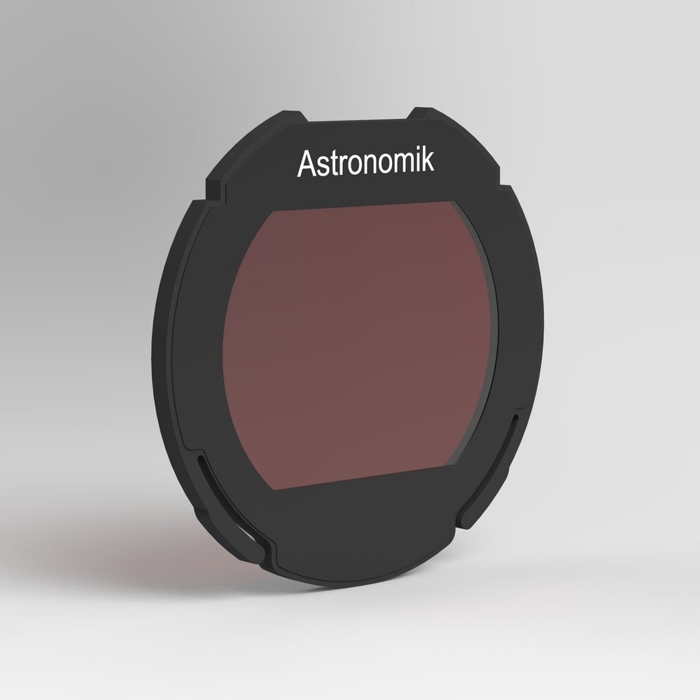
Astronomik H-alpha 12 nm CCD XT Clip-Filter EOS APS-C (Astronomik, SKU: 10203090 / 8h00kh) is ideal for imaging hydrogen nebulae from both light-polluted and dark observing sites. It significantly enhances contrast between objects emitting at 656 nm (H-alpha line) and the sky background.
The filter completely blocks emission lines from high- and low-pressure sodium (Na) and mercury (Hg) lamps, all natural airglow lines, and most scattered moonlight.
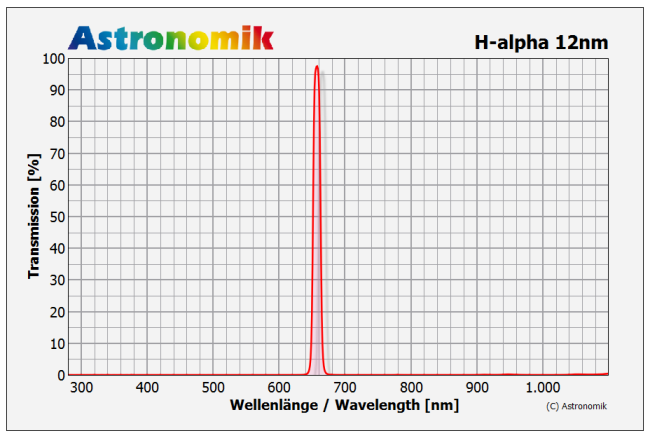
With a narrow 12 nm bandwidth (also available in 6 nm) and very high transmission, the filter effectively blocks all unwanted wavelengths outside 656 nm, from ultraviolet (UV) to infrared (IR).
In areas with low light pollution, background signal is typically limited by sensor dark current rather than sky glow. In such cases, further bandwidth reduction does not reveal additional object detail.
This filter MUST NOT be used for solar observation.
Astronomik narrowband emission-line filters are one of the most effective solutions for imaging under urban skies. The H-alpha filter is typically the first choice for capturing detailed, high-contrast images even under full moon conditions. When combined with OIII and SII filters, it enables HSO (H-alpha, SII, OIII) palette imaging similar to Hubble Space Telescope images.
• 6 nm – ideal for very faint objects in dense star fields and under extreme light pollution
• 12 nm – better suited for typical DSLR, CMOS and CCD cameras with normal or higher dark current and for systems with integrated guiding sensors
Both coatings provide maximum UV–IR blocking, extremely high contrast, minimal scatter, and no halos.
• 12 nm MFR: usable from f/3 to f/∞
• 6 nm MFR: usable from f/4 to f/∞
• 12 nm MaxFR: usable from f/1.7 to f/6 (approx. 85% transmission at f/1.4)
• 6 nm MaxFR: usable from f/2.2 to f/6 (approx. 90% transmission at f/2)
XT filters are designed for wide-angle astrophotography. Their extremely thin substrate (0.3 mm or 0.5 mm) significantly reduces star distortion in the image corners.
• guaranteed transmission above 90% at 656 nm (H-alpha)
• typical transmission: 96% (12 nm) and 93% (6 nm)
• glass thickness: 1 mm (except OWB Type 3 and XT filters)
• finely polished optical glass
• extremely durable coating
• fully resistant to humidity and aging
• Astronomik MFR coating
• parfocal with other Astronomik filters
• diffraction-limited design
• supplied in a durable protective filter box
Each filter undergoes strict quality control and spectrophotometric measurement. Astronomik filters are parfocal and diffraction-limited, ensuring that your optical system’s resolution and contrast remain uncompromised.
|