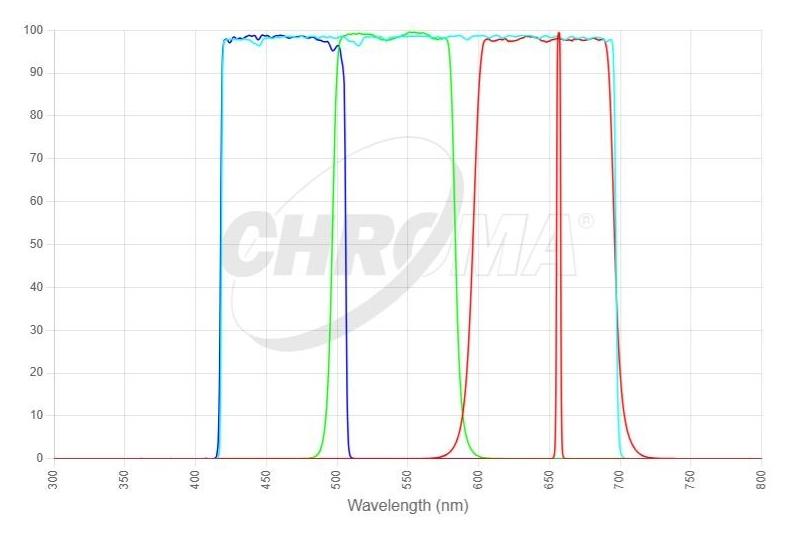
Chroma Ha3LRGB 65x65 mm unmounted filter set (Chroma Technology, SKU: CT-27109-Ha3LRGB-65X65) includes five filters intended for LRGB astrophotography with a monochrome camera. The four broadband filters are complemented by a 3 nm H-alpha filter, enabling the structures of emission nebulae to be recorded at the 656.3 nm hydrogen line. The square 65x65 mm format is designed for installation in a suitably large compatible filter wheel or filter drawer.
• set of five filters for LRGB and H-alpha astrophotography
• 3 nm H-alpha filter providing high contrast and effective background-light suppression when imaging emission nebulae
• matched LRGB filter passbands designed for producing images with natural colors
• durable hard coatings applied by reactive magnetron sputtering
• primary filtering coatings applied to the front surface and anti-reflection coatings applied to the rear surface
• single optical substrates with a thickness of 3 mm
• parfocal design with other Chroma astronomy filters, except LoGlow filters
• standard version designed for optical systems with a focal ratio of f/4 or slower
• square 65x65 mm unmounted format
• Chroma luminance L filter, 65x65 mm, unmounted
• Chroma red R filter, 65x65 mm, unmounted
• Chroma green G filter, 65x65 mm, unmounted
• Chroma blue B filter, 65x65 mm, unmounted
• Chroma 3 nm H-alpha filter, 65x65 mm, unmounted
• manufacturer: Chroma Technology
• set type: Ha3LRGB
• intended use: astrophotography with monochrome cameras
• number of filters: 5
• filter types: luminance L, red R, green G, blue B, H-alpha
• H-alpha filter central wavelength: 656.3 nm
• H-alpha filter bandwidth FWHM: 3 nm
• dimensions of each filter: 65x65 mm
• shape: square
• configuration: unmounted
• substrate thickness: 3 mm
• coating technology: reactive magnetron sputtering
• recommended optical system focal ratio: f/4 or slower
• SKU: CT-27109-Ha3LRGB-65X65
• note: the H-alpha filter is not intended for solar observation
The set enables a consistent LRGB imaging session with additional narrowband H-alpha data acquisition, allowing the natural colors of the object to be combined with clearly rendered structures of emission nebulae.