|
|
|
149 EUR
|
|
price without VAT: 121 EUR
|
| |
") Shop online: Shop online:
● ready for shipping
Shop in Warsaw (qty): 1
● ready for shipping
Shop in Chorzow (qty): 1
● ready for shipping
|
|
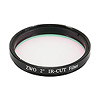
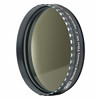
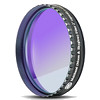
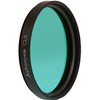
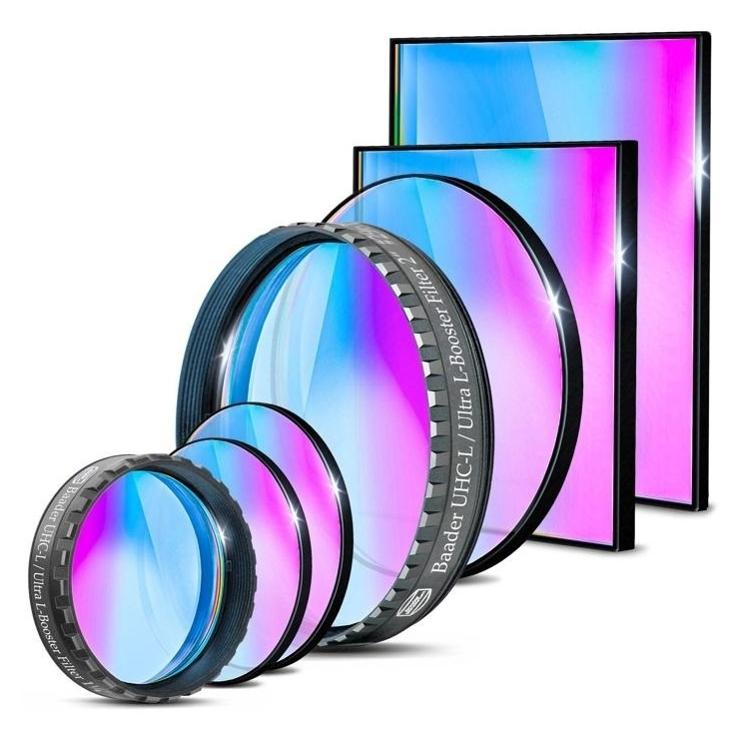
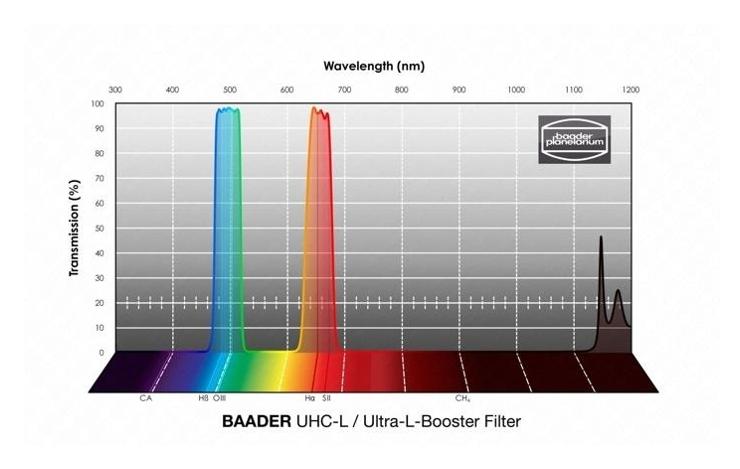
The Baader UHC-L filter is a versatile sky filter, now also blocking the main emissions of LEDs in the blue part of the spectrum. The passband corresponds to a wide two-band filter without distorting the colors of the stars. Both bands allow all light emitted by known emission nebulae (the H-alpha and H-beta lines of hydrogen and the OIII line of oxygen) to pass through, while blocking light pollution from LED lamps and the intense light from car headlights, as well as from regular street lamps street lights and the natural glow of the night sky (airglow/skyglow. The UHC-L filter is mainly used for visual observation and photography of emission nebulae in moderately to highly polluted sky conditions. Its use is also interesting in the observation of comets: It passes the OIII line at 501 nm and the two C2 lines at 511 nm and 514 nm, which are characteristic of the gas tails of many comets.
The UHC-L filter is the successor to the well-known Baader UHC-S filter. It consistently complements it with the advantages of optimization for CMOS matrices (no annoying halo, darkened filter edges, Life-Coat™ coating), while ensuring an improved transmission spectrum adapted to modern LED light pollution. It produces a brighter image than many classic sky anti-light filters (ALP) and is therefore suitable not only for large, light-intensive telescopes, but also for smaller telescopes collecting less light, where it is not possible to achieve large exit pupil. For this reason, the UHC-L filter is a perfect visual complement to narrowband OIII filters.
The UHC-L filter is also perfect for photographic applications. It not only blocks terrestrial light pollution, but also serves as a luminance filter (L filter) because it blocks all UV and IR transmission, like a dedicated UV/IR filter. Cameras without a built-in "UV/IR block" filter therefore generate much sharper images with refractors. Both astrophotographers and EAA/LiveStacking users will benefit from improved star sharpness, better nebula contrast and high H-alpha transmission.
Like all Baader filters optimized for CMOS sensors, Baader UHC-L filters are flat-optically polished, with ultra-hard dielectric coatings using sputtering technology. Even an hour-long bath in boiling water cannot harm them! They are scratch-resistant and can be cleaned as often as necessary. • increased contrast, matched to typical CMOS quantum efficiency and signal-to-noise ratio
• Reflex-Blocker™ coatings, providing the greatest halo freedom ever, even in the most unfavorable secondary optics conditions
• filter thickness identical to existing standards, with the highest attention to parfocality
• blackened edges all around, with an indicator of the filter leading side in the form of a black front outer edge to further eliminate any reflections of light falling on the filter edge.
• each filter individually coated, with a sealed edge of the coating
• life-Coat: increasingly harder coatings ensuring durability of the coating - even in the most unfavorable conditions. • catalog number: 2961563
• weight: 120 g
• spectral classification: band
• transmission: 97%
• size: 2"
• anti-reflection coatings: AR
• weight: 60 g
|