|
|
|
385 EUR
|
|
price without VAT: 313 EUR
|
| |
 Shop online: Shop online:
● ready for shipping
Shop in Warsaw (qty): 4
● ready for shipping
Shop in Chorzow (qty):
● not available
|
|
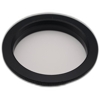
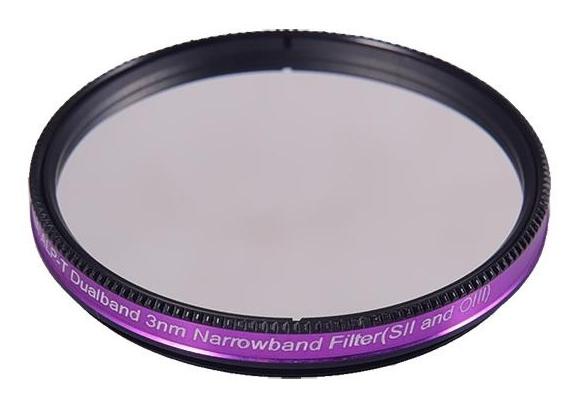
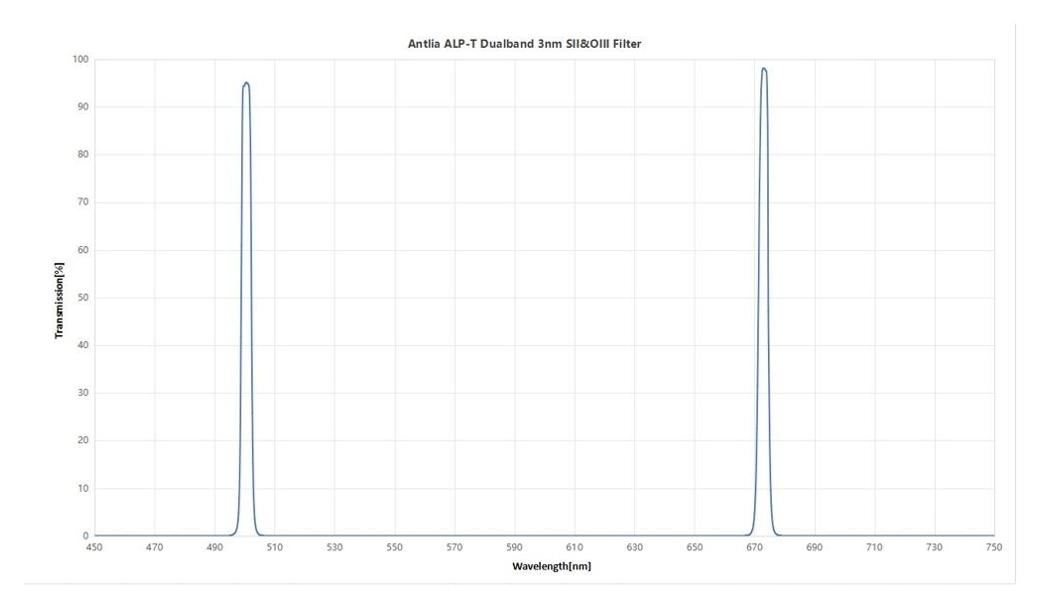
The Antlia ALP-T Dual Band 3nm SII&OIII filter is a high-performance narrowband astrophotography filter designed for color cameras (OSC). It transmits light in two main emission lines: sulfur [SII] (672.4 nm) and oxygen [OIII] (500.7 nm), significantly increasing the contrast of nebulae while effectively blocking light pollution, moonlight, and airglow. With a very narrow bandwidth (FWHM 3 nm) and an out-of-band blocking efficiency of OD4.5, the filter provides excellent signal-to-noise ratio (SNR), which translates into sharp details in nebula structures. Ion Gun Assisted Deposition multi-coating technology and a precision polished optical surface minimize reflections and halo effects around bright stars. The filter works great with telescopes with a f/4 aperture and slower. For faster optics (e.g. f/2.8, f/2.2), it is recommended to use the "highspeed" version with pre-shift. Although primarily intended for OSC cameras, it can also be used with monochrome cameras as a luminance filter to limit exposure time. It is not recommended to use the filter for visual observations or for photography of the Sun. You should definitely not look directly at the Sun through the filter - this can cause permanent eye damage. • Passed bands: SII 672.4 nm and OIII 500.7 nm
• bandwidth (FWHM): 3 nm ±0.5 nm
• peak transmission: 90% (SII), 85% (OIII)
• Out-of-band blocking: ≥OD4.5 in the range of 300–1100 nm
• filter thickness: 2 mm ± 0.05 mm
• optical substrate: single glass, no gluing
• surface quality: 60/40 according to MIL-O-13830
• Transmission wave front: λ/4 or better
• surface parallelism: <30 arc seconds
• frame: 2" (thread M48×0.75)
• finish: black anodized, laser engraving
• design: ultra-thin frame to minimize vignetting • ideal for astrophotography of emission nebulae
• dedicated to color cameras (OSC), can be used with mono cameras
• recommended for f/4 and slower telescopes
• not recommended for visual observations
• not suitable for observing the Sun - it may cause permanent eye damage
|