|
|
 Shop online: Shop online:
● not available
Shop in Warsaw (qty):
● not available
Shop in Chorzow (qty):
● not available
|
|
What distinguishes Geoptik telescopes?
• Mirror surface with guaranteed surface accuracy of 1/8 of the wavefront length. While other manufacturers usually only declare the quality of the mirror, Geoptik confirms it with images of the Ronchi test, Foucalt test, Couder test for the primary mirror and interferometric test for the secondary mirror. Additionally, the mirrors have a reflection test.
Click and see what the Geoptik optical quality certificate looks like
• The design of the telescope guarantees a low obstruction factor (related to the obstruction of the primary mirror by the secondary mirror and its mounting).
• High quality of EQ-5 and EQ-6 mounts (does not apply to telescopes with Dobson mount).
• High quality of materials used - Pyrex glass and BAK-7.
• All telescopes are equipped with a main mirror cooling system (appropriate fans), thanks to which the mirror temperature equalizes the ambient temperature faster (which is especially important in the case of mirrors with a diameter over 150 mm).
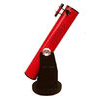
• The mirror surfaces are dusted with aluminum and hardened with SiO2 for maximum durability. A high-class telescope from the Italian company Geoptik for intermediate astronomy enthusiasts. The 150mm diameter mirror allows for advanced visual observations of both celestial bodies in the Solar System and the Deep Sky. The quality of Geoptik telescopes is confirmed by a 5-year manufacturer's warranty. The assembly of the Dobsonian structure is easy to use and reliable. | • Optical system: | Newton's reflector | | • Mirror diameter: | 150mm | | • Lens focal length: | 1200mm | | • Light power: | 1/8 | | • Accuracy of the mirror (confirmed by a certificate): | 1/8λ | | • Maximum useful magnification: | 300x | | • Libra: | 16.6 kg |
The set includes the following accessories: • 1.25'' diameter focuser
• PL 12.5 and 32mm eyepiece
• Dobsonian installation
• 6x30 finder 5 years warranty
This device focuses a large amount of light. Looking directly at the Sun through this device may result in partial or complete loss of vision. To observe the Sun, we recommend the safest method of eyepiece projection, i.e. projecting the image of the disk of our day star onto a piece of paper.
|