|
|
|
1927 EUR
|
|
price without VAT: 1567 EUR
|
| |
 Shop online: Shop online:
● ready for shipping
Shop in Warsaw (qty):
● not available
Shop in Chorzow (qty): 1
● ready for shipping
|
|
The GSO Dobson 16" TRUSS DeLuxe 406/1800 M-CRF telescope is equipped with a high-quality primary mirror in the shape of a rotating paraboloid, with a diameter of 406 mm and a focal length of 1800 mm (f/4.45 focal ratio) in an open-work, open optical tube design. The Taiwanese GSO factory is a renowned supplier of high-class optics, with diffraction-limited quality (i.e. the quality of images is limited only by the nature of light). The telescope allows for obtaining excellent images of both Solar System objects and star clusters, nebulae and galaxies.
The typical, simple concept of Dobsonian telescopes has been optimized in the GSO DeLuxe series telescopes by implementing a number of useful design improvements.
Observation possibilities
The GSO Dobson 16" TRUSS DeLuxe 406/1800 M-CRF telescope is a universal tool for very advanced visual observations of all types of astronomical objects. It will work well in all observing conditions, but - like any astronomical telescope - it loves a dark, rural sky and will show the most under such a sky.
A telescope with a primary mirror diameter of 16 inches (over 40 cm) is basically the maximum of visual observation possibilities available to amateur observers. It is difficult to list all the observation options - so let's list only the most important ones:
• craters on the moon, shadows on impact craters, incredible detail and plasticity
• phases of Mercury and Venus, Venus belts with good atmospheric stability
• ice caps on Mars are perfectly visible (it is worth buying red, orange and yellow filters)
• belts in Jupiter's atmosphere and their structure, both "tropical" and circumpolar, the Great Red Spot, four of Jupiter's moons, the shadows of the moons on the surface of Jupiter's disk
• Saturn's ring with the Cassini and Encke divisions, belts, the ring's shadow on the planet's disk
• the shields of Uranus and Neptune, certain structures in the atmosphere of these planets
• asteroids
• comets - ice blocks that travel through the Solar System - the telescope can serve as an excellent "comet finder"
• hundreds of double, multiple and variable stars, including observations of scientific value
• several thousand Deep Sky objects, including all of the Messier catalog, as well as most of the NGC, IC and Caldwell catalogs; thus, open clusters will be visible, such as the Manger in Cancer, hi chi in Perseus or Ptolemy's Cluster in Scorpius, globular clusters (M13 broken down to 1/2 of its diameter into individual stars, or M53 in Coma Berenices), gas-dust nebulae (the perfectly visible structure of M42 in Orion, North America in Cygnus), galaxies (M31 in Andromeda with two satellite galaxies, i.e. M32 and M110), as well as the Veil in Cygnus or the famous Ring (M57) in Lyra, and much, much more.
Tube
The metal primary mirror cell has 18 optimized support points. As a result, the telescope maintains its collimation for a long time.
Dobsonian mount
The weight and dimensions of the telescope are acceptable in relation to the observation possibilities and the size of the mirror - the tube fits in most cars of the Kombi and SUV type. Thanks to the open-work construction (truss) the telescope, despite the over 40 cm mirror, is not more difficult to transport than 30 cm Newtonian telescopes with a closed tube construction.
Using the telescope is very simple and there is no problem with assembly and operation by one observer. Like any telescope on a Dobsonian box mount, the setting to the object is done in two axes - the azimuth axis (horizontal) and the elevation (vertical). It differs from competing solutions by definitely better bearings in the azimuth - these are roller bearings, guaranteeing on the one hand the smoothness and lightness of the "walk" of the structure, and on the other - higher precision of setting. Metal bearing tracks prevent biting into the wood of the mount, thanks to which a high durability of the mount structure has been achieved. In the elevation axis there is a new bearing system developed by GSO. The telescope is guided and held by two handles. The desired pressure is adjusted using knobs located on both sides of the mount. This is especially helpful when changing the eyepiece to maintain position and balance. Additionally, the telescope has the ability to correct balance by changing the height of the mount.
Spectacle focuser
The telescope is equipped with a high-quality Crayford focuser with a microfocuser with a 1:10 gear ratio. Thanks to this, focusing is very precise even at high magnifications. The focuser is adapted to standard 2" and 1.25" eyepieces.
Advantages of the Crayford focuser:
• much smoother and more precise movement when focusing compared to simpler sliding and rotating focusers
• thanks to the use of a brass ring ( clamp ring ), the attachment of the glasses becomes more secure, the axial alignment is perfectly maintained and scratching of the surface of the glasses sleeve is avoided
Main mirror cooling
The telescope is equipped with a 12V powered fan attached to the end of the tube, which, when turned on, greatly accelerates the equalization of the temperature of the telescope mirror with the ambient temperature.
• openwork optical tube, Dobsonian mount with ball bearings
• carbon tube truss
• Crayford extractor with microfocuser 1:10
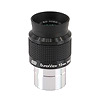
• 30 mm wide-angle Erfle eyepiece (AFOV 70°) / 2" and 9 mm Plossl eyepiece (AFOV 52°) / 1.25"
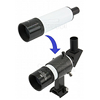
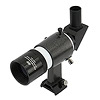
• 8x50 finder with crosshair
• fan to accelerate cooling
• shelf for accessories
• rail for adjusting the center of gravity
Moon planets star clusters nebulae planes
| • Optical system: | Newton's reflector | | • Mirror diameter: | 406mm | | • Lens focal length: | 1800mm | | • Efficiency of the reflecting surface: | 94% | | • Light Force: | 1/4.45 | | • Precision of mirror manufacturing: | 1/8λ | | • Mirror glass type: | BK7 | | • Resolving power: | 0.35 arc seconds | | • Stellar range: | 13.5 magnitude | | • Maximum usable magnification: | 800x | | • Telescope base diameter: | 80cm | | • Dimensions in factory boxes + weight: | 1. main mirror: 62 x 62 x 41 cm, 10 kg
2. tube: 75 x 63 x 63 cm, 35 kg
3. base: 93 x 93 x 21 cm, 32 kg | | • Libra: | 58 kg (tube: 33 kg, assembly: 25 kg) |
2 years

(note: the photos below show an earlier version of the piping, currently a stronger truss structure "two to one support point" as in the photo above) 


>> FREQUENTLY ASKED QUESTIONS << Question : Is the mirror made of Pyrex? Is there a version with a Pyrex mirror? Is BK-7 a Pyrex? Which is better, Pyrex or BK-7? Why is the mirror not made of Bak-4 glass? Answer: Pyrex is the trade name for borosilicate offered by Corning. Many companies offer glass with the same composition and parameters, but often the proper name Pyrex is used to describe borosilicate glass (a bit like sports shoes are called Adidas). A characteristic feature is that this glass has a thermal expansion coefficient that is about three times smaller.
From the point of view of an astronomy enthusiast, its advantage is that it achieves the figure a bit faster when the telescope cools down, e.g. after taking it out of the house into a frosty yard. It should be noted that using Pyrex in amateur telescopes (6" - 16") is not necessary, because these mirrors are quite thin and cool down quickly. However, cooling the mirror itself, achieving the appropriate figure by it, is not everything - the tube must also reach the ambient temperature, otherwise turbulence appears inside the tube and the image will be of poor quality. In practice, it is important for the ENTIRE telescope to be at a temperature close to the ambient temperature.
BK-7 is a decent optical glass, commonly used also in the best optical systems. It is not bad glass, as is sometimes believed. What is more, from the point of view of the user of a Newtonian telescope, the optical characteristics of the glass are irrelevant - the important element is the figure of the mirror and the properly applied reflective layer. The physical characteristics of the glass may be important - the mirror itself is only a "support" for the reflective layer. To answer briefly:
• no, GSO telescope mirrors are not made of Pyrex, they are made of BK-7 glass
• BK-7 is not Pyrex
• Pyrex is more expensive, but its use must be justified; in the case of a cooled telescope there is no difference in the images obtained between Pyrex and BK-7
• BaK-4 is a rather expensive optical glass with a high refractive index, used practically exclusively in prisms (telescopes, binoculars, in angle connectors with Amici prisms, etc.), of little use and rarely used in lenses and eyepieces
• the presence of active cooling ("fan") at the back of the mirror shortens the cooling time of the mirror to 15 - 30 minutes, thus eliminating the difference between BK-7 and Pyrex.
|