

Astronomik SII 12nm CCD 50mm (SKU: 10216540 / 8h00e0)

Description
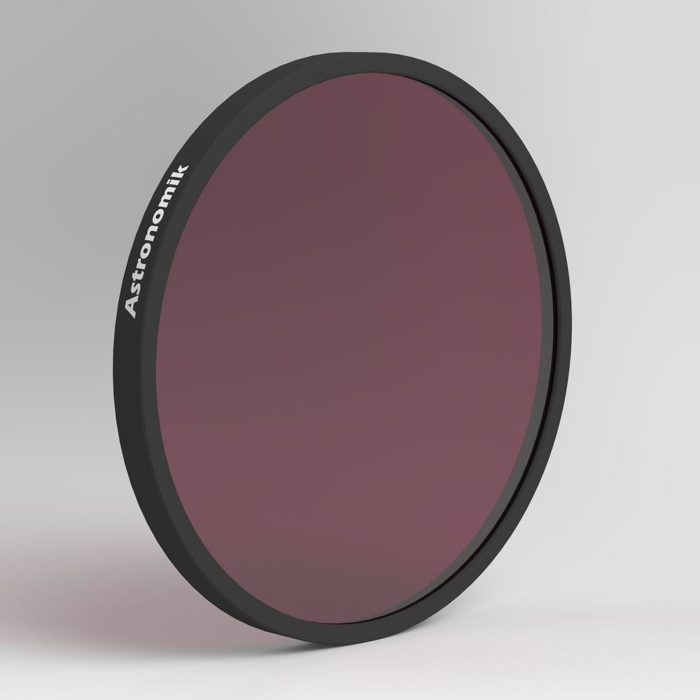
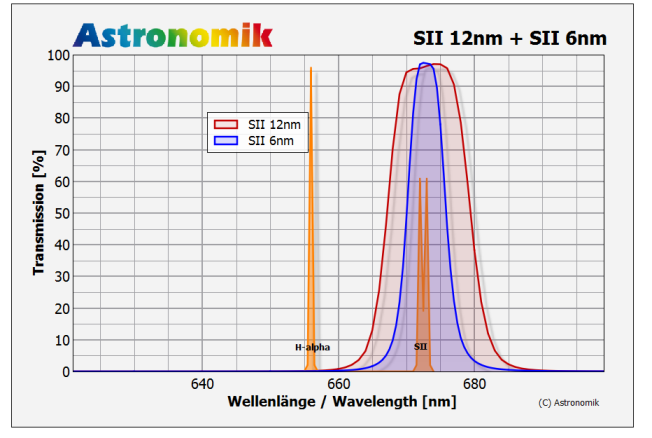
Astronomik SII 12 nm CCD Filter 50 mm (SKU: 10216540 / 8h00e0) is a narrowband filter designed for imaging sulfur-emission nebulae. It works effectively both under light-polluted skies and at dark observing sites. The filter significantly increases contrast between objects emitting at the SII lines (671.7 nm and 673.0 nm) and the sky background.
The filter effectively blocks emission lines from artificial lighting sources such as sodium (Na) and mercury (Hg) lamps, as well as natural airglow and most scattered moonlight. This results in a much darker background and improved visibility of faint nebular structures.
Thanks to its narrow full width at half maximum (FWHM) and very high transmission, the filter passes only the key sulfur emission lines while blocking nearly all unwanted wavelengths from ultraviolet (UV) to infrared (IR).
In areas with low light pollution, the image background is often limited by the sensor’s dark current rather than sky brightness. In such conditions, further narrowing the bandwidth does not necessarily reveal additional object detail.
Imaging with Astronomik narrowband filters
Astronomik narrowband emission-line filters allow astrophotographers to capture high-quality deep-sky images even under severe light pollution. An H-alpha filter is usually the first choice, enabling detailed imaging of red emission nebulae even during full Moon.
OIII filters expand imaging possibilities by capturing greenish and bluish structures typical for planetary nebulae, star-forming regions and supernova remnants.
Adding an SII filter enables imaging in the HSO (H-alpha, SII, OIII) palette, also known as the “Hubble palette”, producing spectacular false-color emission-line images.
Differences between SII 4 nm, 6 nm and 12 nm filters
4 nm and 6 nm filters are ideal for imaging very faint objects in star-rich regions of the Milky Way. They are also recommended for cameras with extremely low dark current or for imaging from locations with extreme light pollution.
The 12 nm filters were designed for typical DSLR cameras with CMOS sensors and CCD cameras with normal or higher dark current. They are also the preferred choice for cameras with integrated guiding sensors because they reveal more guide stars.
Astronomik MFR vs MaxFR coatings
Both MFR and MaxFR coatings provide excellent blocking across the entire spectral range from UV to IR, extremely high contrast, minimal scattered light, no halos and sharp star images.
MFR:
• 12 nm – f/3 to f/∞
• 6 nm – f/4 to f/∞
• 4 nm – f/4.5 to f/15
MaxFR coatings are designed for very fast optical systems:
• 12 nm – fully usable from f/1.7 to f/6 and about 85% of maximum transmission at f/1.4
• 6 nm – fully usable from f/2.2 to f/6 and about 90% of maximum transmission at f/2
• 4 nm – currently under development
Technical specifications
• guaranteed transmission above 90% at both SII lines: 671.7 nm and 673.0 nm
• typical transmission: 96% (12 nm) and 93% (6 nm and 4 nm)
• filter diameter: 50 mm
• glass thickness: 1 mm (except OWB Type 3 and XT filters)
• finely polished optical glass free of internal stress and bubbles
• extremely durable coating resistant to humidity and aging
• Astronomik MFR coating
• parfocal with other Astronomik filters
• diffraction-limited performance
• optimized transmission ranges
• supplied in a durable protective filter box
Astronomik filters are designed to preserve the optical resolution and contrast of your telescope. Each filter undergoes strict quality control, and narrowband emission-line filters are individually measured with a PerkinElmer spectrophotometer to verify compliance with published specifications.
Product code: FILAST50-8H00E0_AIK
Reviews
Write a reviewNo reviews yet. Be the first to share your opinion.